
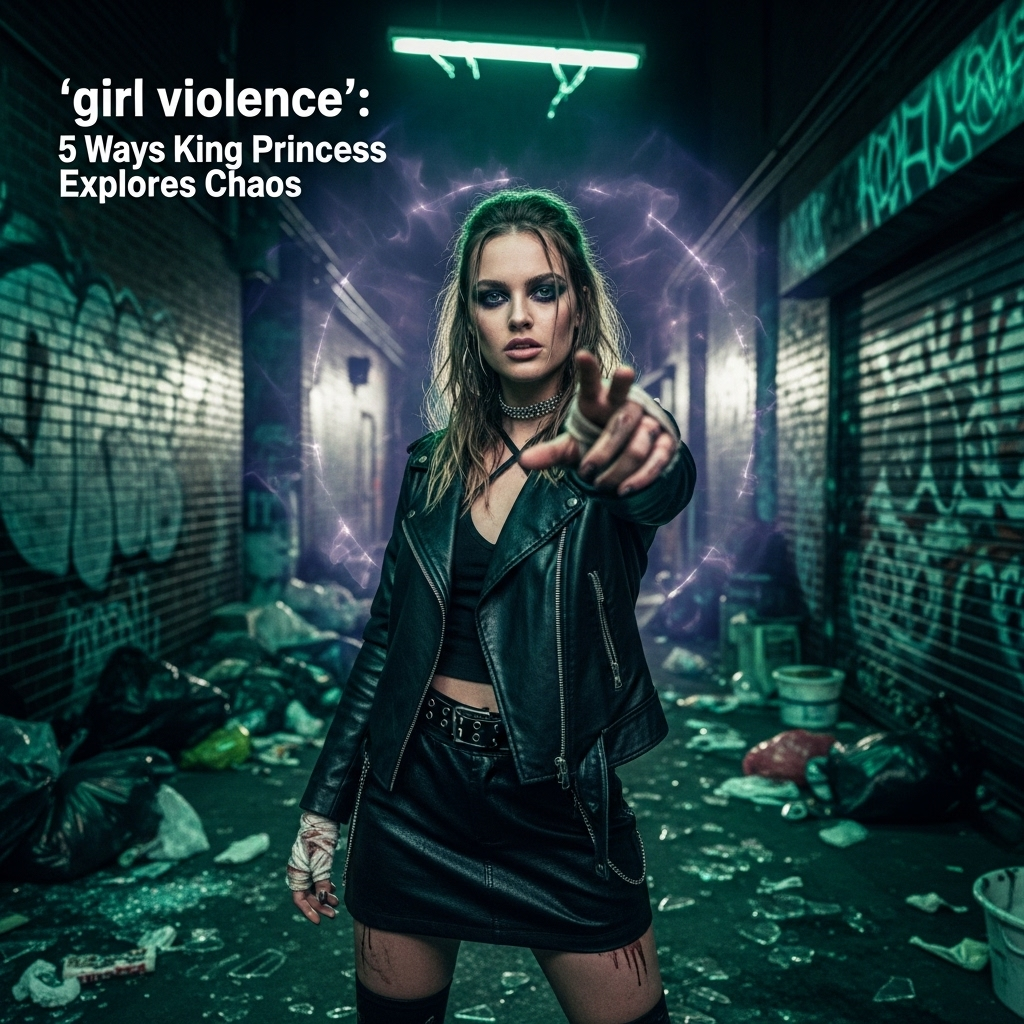
‘‘girl violence’: 5 Ways King Princess Explores Chaos
In the modern pop landscape, the term ‘girl violence’ has emerged not as a descriptor of physical aggression, but as a label for the raw, messy, and often self-destructive emotional chaos that women and queer artists are exploring with newfound honesty. It’s the sound of a heart breaking in a mosh pit, the poetry of a doomed relationship, the beauty in a total meltdown. And few artists embody this ethos more completely than Mikaela Straus, better known as King Princess.
From her breakout hit “1950” to her critically acclaimed albums, King Princess has made a career of dissecting the beautiful disaster of love, lust, and identity. She doesn’t just write songs about heartbreak; she crafts immersive experiences of it. This isn’t polished, radio-friendly sadness. This is the visceral, complex, and utterly compelling world of ‘girl violence’, a concept we explored in our feature on the new wave of pop angst.
In This Article:
1. Lyrical Confessions: Diaries of Disarray
At the core of King Princess’s exploration of chaos are her lyrics. They read less like carefully crafted pop verses and more like frantic, tear-stained diary entries. She leans into the ugly parts of desire—the jealousy, the desperation, the obsessive pining—and presents them without a filter. Her words capture the internal monologue of someone spiraling, turning emotional turmoil into a poetic art form.
In the song “Pain,” she literally begs for her feelings to be validated through suffering, singing, “So if you’re gonna screw me, then screw me with your friends / And if you’re gonna love me, love me to the end.” It’s a perfect example of her approach: taking a complex, toxic thought and laying it bare. She doesn’t shy away from admitting to possessiveness or the desire to be consumed by a relationship, good or bad.
This lyrical honesty is the foundation of her take on the ‘girl violence’ theme. It’s a declaration that the messy, contradictory feelings that come with intense love are not something to be hidden, but something to be screamed, analyzed, and ultimately, understood.

2. Sonic Dissonance: The Sound of a Meltdown
King Princess masterfully uses her music’s production to mirror the lyrical chaos. Her songs are rarely straightforward. They build, break, and often swerve into unexpected territory. She will pair a soft, vulnerable vocal delivery with a sudden explosion of fuzzed-out guitar or a heavy, industrial synth bass. This contrast is intentional and incredibly effective.
Take her album Hold On Baby. You can read our full thoughts in our album review. Tracks like “Let Us Die” start with a gentler tone before descending into a full-blown rock anthem, complete with a shredding guitar solo. The sonic journey of the song mirrors an emotional one: from quiet contemplation to a cathartic release of rage and passion. It’s the musical equivalent of going from crying to laughing to screaming all within a few minutes.
This sonic dissonance prevents the listener from getting comfortable. It keeps you on edge, mimicking the feeling of an unstable relationship or a volatile emotional state. The music doesn’t just support the lyrics; it actively participates in the chaos, making the experience all the more immersive. You can explore her dynamic sound further on her official Spotify page.
3. Visual Storytelling: Aesthetics of Anarchy
The ‘girl violence’ aesthetic extends powerfully into King Princess’s music videos and visual identity. She rejects the hyper-polished, flawless look of many modern pop stars in favor of something more gritty, real, and beautifully undone. Her visuals often feature mundane settings—a messy bedroom, a drab bathroom, a suburban garage—that become the backdrop for intense emotional dramas.
The video for “Only Time Makes It Human” is a prime example. We see a CGI avatar of King Princess, glitchy and raw, navigating a sterile world while she sings about the messy, organic process of getting over someone. The visual disconnect speaks volumes about feeling alienated and out of sync with your own emotions.
Her music videos often feel like short films about the quiet moments of a breakdown. There’s no big, choreographed dance number. Instead, there’s the intimacy of a pained expression, the symbolism of a trashed room, or the lonely imagery of her performing to an empty space. It’s a visual language that says being a wreck is not only okay, it can be its own form of art.

4. Live Energy: Channeling ‘girl violence’ on Stage
Nowhere is the concept of ‘girl violence’ more apparent than in a King Princess live show. On stage, the internal chaos she sings about becomes a physical, externalized force. She commands the stage with a swagger that is both confident and teetering on the edge of coming undone. It’s a raw, unfiltered expression of energy that is captivating to watch.
She thrashes her guitar, headbangs with abandon, and allows her voice to crack with emotion. There’s no pretense of perfection. If a note is sharp or a chord is messy, it only adds to the authenticity of the performance. Her shows feel less like a recital and more like a collective exorcism, where the audience is invited to release their own pent-up frustrations and heartaches alongside her.
This live energy is crucial. It proves that the chaos in her music isn’t a studio invention. It’s a genuine part of her artistic DNA. For more on artists challenging genre norms, check out our piece on the rise of genre-bending pop.

5. Subverting Pop Femininity: A Rebellion Against Polish
Finally, King Princess explores chaos by fundamentally subverting what a female pop star is “supposed” to be. In an industry that often demands pristine vocals, perfect choreography, and a carefully managed public image, she chooses to be unapologetically human.
Her androgynous style, her candid discussion of her queer identity, and her embrace of “unflattering” emotions all serve as a rebellion against the narrow confines of traditional pop femininity. This rejection of polish is, in itself, an act of ‘girl violence’—a violent tearing down of expectations and norms.
She shows her audience that strength isn’t about being impervious; it’s about being vulnerable and surviving the chaos. By refusing to present a sanitized version of herself, King Princess creates space for her listeners to embrace their own complexities. She makes pop music for people who have been told they are “too much”—too loud, too needy, too emotional—and tells them that their “too much” is actually just enough.
The Art of the Beautiful Mess
King Princess has carved out a unique and vital space in music by turning chaos into a compelling art form. Through her painfully honest lyrics, dissonant soundscapes, raw visuals, and electrifying live shows, she has become a key architect of the ‘girl violence’ movement. She reminds us that there is profound strength in vulnerability and an undeniable beauty in falling apart. In her hands, chaos isn’t the end of the story; it’s the most interesting part of the journey.
“`


