
Men’s Tennis Legends: How Alcaraz Ranks at Age 22
The conversation around men’s tennis legends has been dominated by three names for two decades: Federer, Nadal, and Djokovic. But as the sun sets on that golden era, a new force has emerged with breathtaking speed and skill. Carlos Alcaraz, the Spanish phenom, isn’t just winning; he’s rewriting the record books. At just 22 years old, his accomplishments already demand a fascinating, and perhaps premature, comparison: how does he stack up against the very best at the same age?
Table of Contents
The Alcaraz Phenomenon: A New Era Begins
By his 22nd birthday, Carlos Alcaraz has already carved out a career that many seasoned professionals would envy. It’s not just the raw statistics, but the manner of his victories that has captured the world’s attention. His game is a dizzying blend of explosive power, delicate touch, and a court coverage that defies geometry.
Let’s look at the hardware. As of September 2025, Alcaraz has already secured four Grand Slam titles. His breakthrough at the 2022 US Open was followed by a historic victory at Wimbledon in 2023, a dominant run at the French Open in 2024, and another hard-court triumph. This versatility across all surfaces is a hallmark of the greats and something Alcaraz established exceptionally early.
Beyond the Slams, he has collected multiple Masters 1000 titles and has spent significant time as the world’s #1 ranked player. His rivalry with Jannik Sinner has already produced classic matches, providing the sport with the compelling narrative it needs post-Big Three. He plays with a joy and fearlessness that is simply infectious, making him a commercial and fan favorite. His rise is not just a transition; it’s a takeover.

Comparing to the Big Three at Age 22
To truly contextualize Alcaraz’s start, we must place it alongside the players who set the modern standard. How did Roger, Rafa, and Novak look when they were 22?
Roger Federer
By the time Roger Federer turned 22 in August 2003, he was a prodigious talent, but not yet the titan he would become. He had one Grand Slam title to his name—Wimbledon, captured just a month before his birthday. While recognized as a future star, few could have predicted the sheer dominance that would follow. At this age, Alcaraz is significantly ahead of Federer’s Grand Slam pace.
Rafael Nadal
Here is where the comparison becomes truly electrifying. Rafael Nadal was an absolute force of nature from his teenage years. By his 22nd birthday in June 2008, the “King of Clay” had amassed an astonishing four French Open titles and his first Wimbledon championship, totaling five Grand Slams. Nadal’s early-career numbers are the benchmark for prodigies, and Alcaraz’s four slams put him in this elite, rarefied air.
Novak Djokovic
Novak Djokovic, the eventual all-time leader in men’s singles Grand Slams, had a slower burn compared to Nadal and Alcaraz. By his 22nd birthday in May 2009, he had one Grand Slam title, the 2008 Australian Open. Like Federer, he was a top player and a clear threat, but his legendary consistency and all-conquering form would be honed over the next few years. Again, Alcaraz’s current trajectory is well ahead of Djokovic’s at the same age.

How Alcaraz Stacks Up Against Other Men’s Tennis Legends
The “Big Three” are the modern standard, but the history of men’s tennis legends is rich with icons who started fast. Broadening our comparison gives us even greater perspective on Alcaraz’s historic pace.
Björn Borg, the stoic Swede, was another early bloomer. By the time he was 22, Borg had already won five Grand Slams (three French Opens, two Wimbledons). His early success is a direct parallel to Nadal’s and serves as a historical precedent for the kind of dominance Alcaraz is showing.
American powerhouse Pete Sampras turned 22 in August 1993. At that point, “Pistol Pete” had secured three Grand Slam titles: the US Open in 1990 and 1992, and Wimbledon in 1993. This puts him just behind Alcaraz’s current pace. For more on how these players rank in the all-time hierarchy, you can read our deep dive into The GOAT Debate in Men’s Tennis.
These comparisons are not meant to definitively declare Alcaraz as a future GOAT. Instead, they illustrate that his performance is not just great for his age—it’s historically significant. He is on a trajectory reserved for a handful of the most iconic players ever to pick up a racquet.
Intangibles and Future Projections
Statistics tell only part of the story. The true test for joining the pantheon of legends is longevity, adaptability, and the mental strength to stay at the top. Alcaraz possesses a champion’s mindset, but the pressures are immense. He is no longer the hunter; he is the hunted.
Key factors that will define his legacy include:
- Injury Management: His physical, all-out playing style is demanding. Staying healthy for 15+ years is perhaps the single greatest challenge for any modern tennis player.
- Adaptability: As he ages and new challengers emerge, Alcaraz will need to evolve his game. The Big Three were masters of reinvention, and Carlos must prove he can do the same.
- Mental Fortitude: Handling the immense pressure of being the “next big thing” and the face of tennis is a burden. His cheerful demeanor is an asset, but the weight of expectation is heavy.
The landscape of the ATP Tour is constantly shifting. New rivals will rise, and Alcaraz will need to answer every challenge. His success so far suggests he has the tools, but only time will tell.
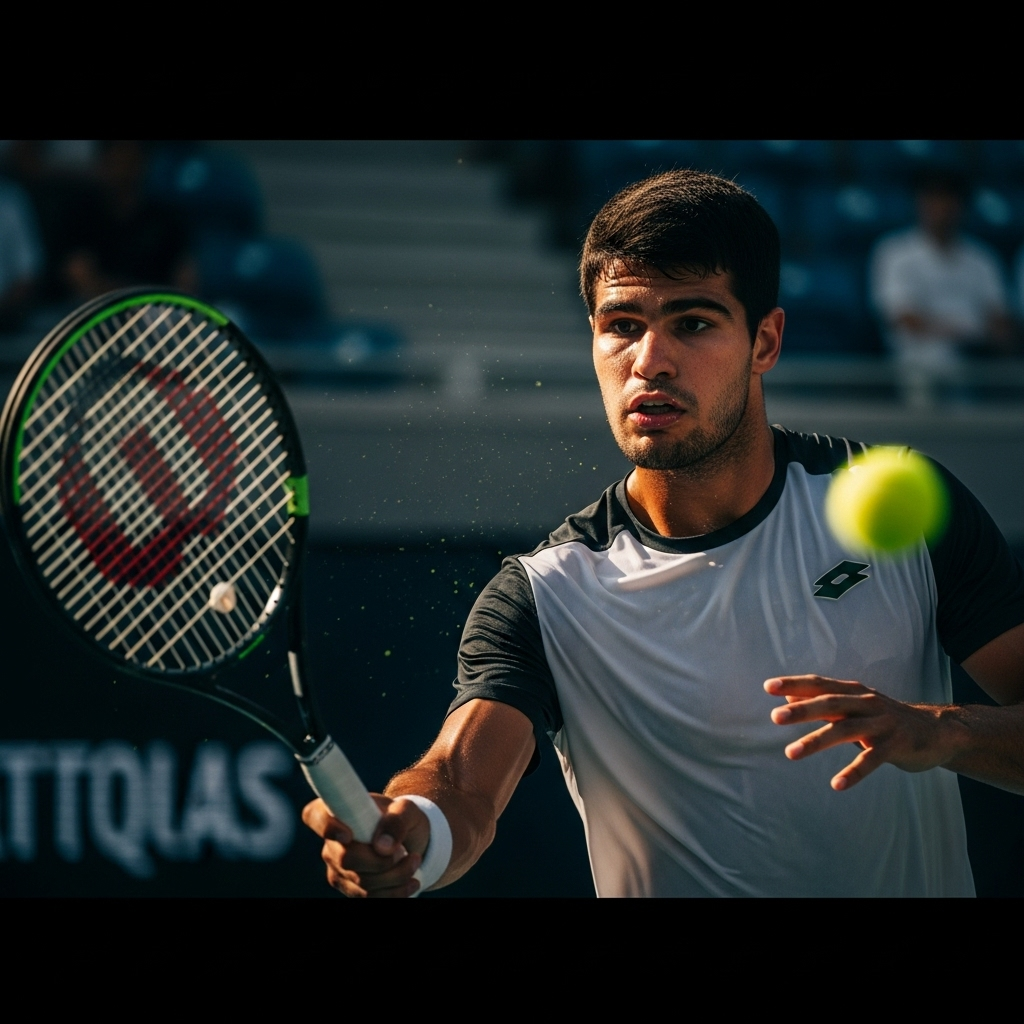
Conclusion: A Legend in the Making?
So, how does Carlos Alcaraz rank among the legends at age 22? The numbers speak for themselves. His Grand Slam count is ahead of Federer and Djokovic and is comparable to the blistering starts of Nadal and Borg. He has demonstrated mastery on all surfaces and has embraced his role as a leader of the new generation.
He is, without a doubt, on a legendary pace. While it is far too early to place him in the same sentence as the fully-formed Big Three, he has passed every test with flying colors. The foundation he has built is not just strong; it’s historic.
The ultimate question of whether he will convert this incredible start into a 15-year career of dominance remains unanswered. But for now, we are witnessing the ascent of a player who has the potential to redefine the very concept of men’s tennis legends for a new generation. The future of tennis is here, and his name is Carlos Alcaraz.


