
Lobbies EU: Trump Pushes 100% Tariffs on China & India
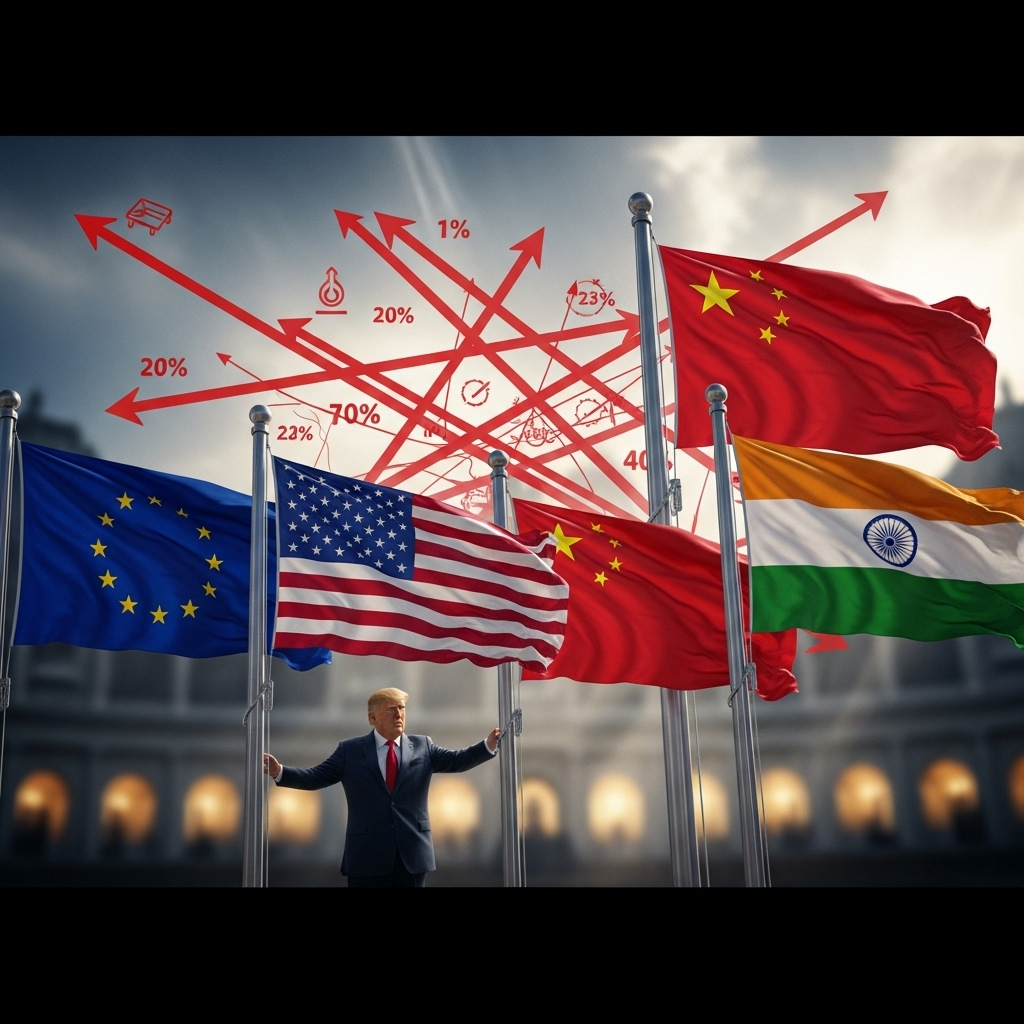
In a move poised to radically reshape global trade, former President Donald Trump is reportedly advocating for a staggering 100% tariff on all goods from China and India. More significantly, his team actively lobbies EU officials and political allies to join what he frames as a necessary economic realignment against unfair trade practices. This aggressive stance signals a potential return to the “America First” trade wars, but on a scale that could dwarf his first term’s economic policies.
Trump’s 100% “Reciprocal” Tariff Plan Explained
The core of Trump’s proposal is what he calls a “reciprocal tariff.” The idea is simple in theory: if a country places a certain tariff on U.S. goods, the U.S. should impose the exact same tariff on theirs. However, his latest proposal targets China and India with a blanket 100% tariff, a figure that goes far beyond simple reciprocity and acts as a de facto economic blockade.
This isn’t a new theme for Trump, who has long criticized what he sees as predatory trade tactics from Beijing and, increasingly, New Delhi. During his presidency, he initiated a trade war with China, imposing tariffs on hundreds of billions of dollars worth of goods. You can read our analysis on previous trade wars to understand the context. This new proposal, however, is a dramatic escalation.
A 100% tariff would effectively double the price of all imported goods from the two Asian giants overnight. For American consumers, this means everything from iPhones and electronics to clothing, furniture, and pharmaceuticals could become prohibitively expensive if they originate from China or India.
How Trump’s Team Lobbies EU for a United Front
The most critical new development is the focused effort to bring the European Union into this economic coalition. Sources close to the former President’s advisors confirm that his team actively lobbies EU member states, arguing that a united Western front is the only way to force significant changes in Chinese and Indian industrial and trade policies.
This lobbying effort is multi-pronged:
- Informal Channels: Surrogates are meeting with conservative and populist party leaders across Europe who are sympathetic to economic nationalism.
- Public Statements: Trump and his allies are using media appearances and rallies to publicly call on Europe to “stand with” the U.S. against economic adversaries.
- Policy Proposals: Think tanks aligned with Trump’s movement are circulating papers in Brussels outlining the supposed long-term benefits of decoupling from Asian manufacturing hubs.
The central argument is that while the EU’s economy would face short-term pain, joining the U.S. in this tariff wall would protect its own industries from being undercut in the long run. The pitch is that it’s better to act in concert now than to be picked off one by one. However, this is a tough sell in many European capitals, particularly Berlin, which relies heavily on exports to China.
The Staggering Economic Consequences
Economists from across the political spectrum are sounding the alarm about the potential fallout. A coordinated 100% tariff by both the U.S. and the EU would be an unprecedented shock to the global economic system, likely triggering a severe global recession.
For China and India, the impact would be catastrophic. Their export-oriented economies would face a sudden and near-total collapse of access to two of the world’s three largest consumer markets. This could lead to mass unemployment and social instability.
For the European Union, the decision is fraught with peril. While some industries might benefit from reduced competition, many of Europe’s largest companies, from automakers to luxury brands, depend on the Chinese market for a significant portion of their revenue. Retaliatory tariffs from China and India would be swift and damaging. The World Trade Organization (WTO), already weakened, would likely be rendered powerless to mediate the conflict.
For U.S. consumers and businesses, the cost of living would skyrocket. The inflationary pressure from doubling the cost of a vast array of goods would be immense, hitting lower and middle-income families the hardest.
Rattling the Global Supply Chain
Beyond the immediate financial costs, such a policy would shatter the intricate global supply chains built over the last four decades. Companies have optimized their operations by manufacturing components and assembling products in different parts of the world to maximize efficiency and minimize cost.
A 100% tariff wall would force a frantic and expensive scramble to “reshore” or “near-shore” production. While proponents argue this would bring manufacturing jobs back to the U.S. and Europe, the transition would take years, if not decades. In the interim, businesses would face massive disruptions, and many would not survive.
Sourcing new suppliers, building new factories, and retraining workforces is a monumental task. The immediate result would be shortages, production halts, and a level of economic chaos not seen in generations. The strategy that Trump lobbies EU leaders to adopt assumes this transition is not only possible but beneficial—a highly debatable premise.

What’s Next for Transatlantic Trade?
As of now, the proposal remains a key talking point for a potential future Trump administration. The response from Brussels has been publicly cool, with most mainstream European leaders committed to the current rules-based international order. However, the political landscape in Europe is shifting, and the appeal of economic protectionism is growing in some quarters.
The aggressive campaign that lobbies EU decision-makers ensures this will be a central topic of debate in the coming months. Global corporations, governments, and consumers are watching closely. The outcome will determine whether the world economy continues on a path of globalization or enters a new, uncertain era of great power economic confrontation.
For now, the world holds its breath, caught between the established order and a populist push that threatens to upend it entirely. The future of your wallet, and the global economy, may hang in the balance.
“`


