
Only two continents have won the 22 FIFA World Cups
The FIFA World Cup is the planet’s most-watched sporting event, a global festival where nations unite in a shared passion for football. Yet, for all its worldwide reach, the tournament’s ultimate prize has been an incredibly exclusive affair. In the 90+ year history spanning 22 tournaments, it’s a staggering fact that only two continents have ever produced a World Cup champion: Europe and South America. This remarkable duopoly has defined international football’s highest level, creating a narrative of sustained dominance and frustrating near-misses for the rest of the world.
This article delves into the history of this continental dominance, explores the factors behind it, and asks whether any nation from Africa, Asia, or North America can finally break the mold.
In This Article
The South American Powerhouses: Samba and Steel
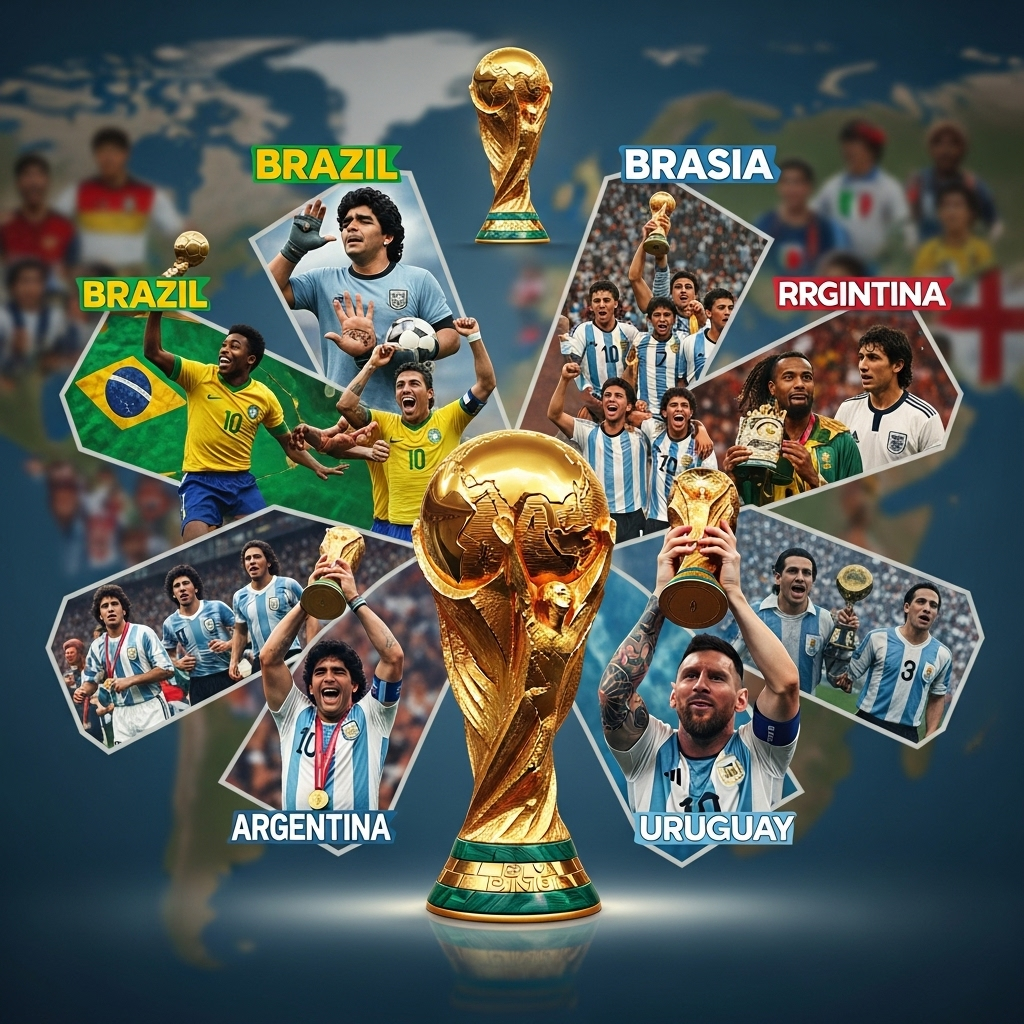
South America, represented by the confederation CONMEBOL, has a rich and storied history in the World Cup. Their nations have lifted the trophy a combined 10 times. The continent’s success is largely built on the shoulders of three footballing giants.
Brazil: The most successful nation in World Cup history, Brazil stands alone with five titles (1958, 1962, 1970, 1994, 2002). From the magic of Pelé in the mid-20th century to the flair of Ronaldo and Ronaldinho in the modern era, the Seleção has become synonymous with beautiful, attacking football. Their 1970 team is often regarded as the greatest international side ever assembled.
Argentina: With three titles (1978, 1986, 2022), Argentina has consistently been a formidable force. Their success is forever linked to two of the game’s greatest players: Diego Maradona, whose divine and controversial performance led them to glory in 1986, and Lionel Messi, who completed his footballing legacy by captaining his nation to victory in 2022.
Uruguay: Though their success came in the tournament’s early days, it was foundational. Uruguay won the inaugural World Cup in 1930 on home soil and shocked Brazil in the 1950 final at the Maracanã, an event so traumatic it was nicknamed the Maracanazo. These two titles cemented South America’s place as an early footballing superpower.
The continent’s style is often characterized by individual brilliance, technical skill, and a fierce, unyielding passion for the national shirt. For more on jejich legendary wins, check out our deep dive on the greatest World Cup finals of all time.
The European Dynasty: Tactics and Talent
While South America boasts flair, Europe, represented by UEFA, counters with tactical discipline, depth, and overwhelming numbers. European nations hold the edge with 12 titles spread across five different countries. This demonstrates a broader base of elite teams capable of reaching the pinnacle.
Germany: A model of consistency and efficiency, Germany (including as West Germany) has won four World Cups (1954, 1974, 1990, 2014). Known for their mental fortitude and tactical adaptability, the Die Mannschaft are perennial contenders, having reached an incredible eight finals.
Italy: Another four-time winner (1934, 1938, 1982, 2006), Italy’s success has often been built on a foundation of resolute, strategic defending. The Azzurri have perfected the art of navigating knockout tournaments, grinding out results with tactical masterclasses.
France: A more recent powerhouse, France has claimed two titles (1998, 2018) and finished as runners-up twice. Benefiting from world-class youth development systems, Les Bleus have produced an astonishing pipeline of talent, including legends like Zinedine Zidane and modern superstars like Kylian Mbappé.
Spain & England: Spain’s “golden generation” secured their lone title in 2010 with a revolutionary ‘tiki-taka’ style of possession-based football. England won their only World Cup in 1966 on home turf, a moment of national pride that still echoes in their footballing culture.

Why Have Only Two Continents Dominated?
The concentration of success within only two continents is not a coincidence. It is the result of a powerful combination of historical, economic, and cultural factors that created a self-perpetuating cycle of dominance.
- Historical Head Start: The first World Cup in 1930 featured teams predominantly from Europe and South America. These continents established the traditions, rivalries, and professional structures decades before football gained a serious foothold elsewhere.
- Economic Power & Infrastructure: The world’s wealthiest and most prestigious professional leagues are in Europe (the Premier League, La Liga, Serie A, Bundesliga). These leagues attract the best players from all over the globe, providing them with elite coaching, facilities, and competition. This gives European players—and South Americans who play there—a significant competitive advantage.
- Deep-Rooted Football Culture: In nations like Brazil, Argentina, Germany, and Italy, football is more than a sport; it’s a part of the national identity. This cultural obsession fuels grassroots participation, creates intense pressure to succeed, and ensures a constant focus on developing the next generation of world-class players.
- UEFA & CONMEBOL Influence: As the two most successful confederations, UEFA and CONMEBOL have historically held significant influence within FIFA, the sport’s governing body. This has often translated into more World Cup qualification spots, further increasing their chances of success.
This combination of factors has created a high barrier to entry for nations from other continents, who often play catch-up in terms of resources, experience, and top-level player development.
The Challengers: Can Other Continents Break Through?
Despite the duopoly, teams from other continents have come tantalizingly close, providing some of the World Cup’s most memorable underdog stories. These performances show that the gap, while still significant, may be closing.
Africa (CAF): The continent came closest in 2022 when Morocco made a historic run to the semi-finals, defeating giants like Spain and Portugal along the way. Before that, Cameroon (1990), Senegal (2002), and Ghana (2010) all reached the quarter-finals, only to be narrowly eliminated. African teams often possess incredible athleticism and individual talent.
Asia (AFC): South Korea’s incredible co-host run to the semi-finals in 2002 remains the best performance by an Asian team. Japan has also become a regular in the knockout stages, known for its technical proficiency and discipline. The continued investment in domestic leagues in countries like Japan and Saudi Arabia is raising the overall standard.
North America (CONCACAF): The United States reached the semi-finals way back in 1930, but their best modern performance was a quarter-final appearance in 2002. Mexico has been a model of consistency, reaching the Round of 16 in seven consecutive tournaments, though they have struggled to cross that hurdle. With the USA, Mexico, and Canada hosting in 2026, the region is poised for its best showing yet.

The Future of Global Football
The trend of only two continents winning the World Cup is one of football’s most enduring statistics. However, the future may look different. The 2026 World Cup will expand from 32 to 48 teams, providing more qualification spots for nations in Africa, Asia, and North America.
This expansion, combined with increased investment in grassroots football globally and more players from developing nations gaining experience in top European leagues, could be the catalyst for change. While it remains a monumental task to unseat the European and South American giants, Morocco’s 2022 heroics proved that on the world’s biggest stage, anything is possible. The dream of a new continental champion is more alive than ever before.


