
Focus shifts: 1 architect of LA ICE raids now in Chicago
The landscape of federal immigration enforcement in the American Midwest is set for a potential seismic change. A high-ranking official, widely credited as a key architect of the controversial large-scale Immigration and Customs Enforcement (ICE) raids in Los Angeles from 2021 to 2023, has been quietly reassigned to head the Chicago field office. As the focus shifts from the West Coast to the heart of the Midwest, immigrant communities and civil rights advocates in Chicago are bracing for what they fear is a new era of aggressive enforcement.
The official, Deputy Field Office Director Marcus Thorne, is known for his data-driven, multi-location enforcement strategies that led to a significant increase in arrests in Southern California. His transfer signals a possible strategic realignment within the Department of Homeland Security, raising questions about a change in priorities and tactics for the Chicago region, a long-standing “Sanctuary City.”
Contents
Thorne’s Controversial LA Legacy
To understand the apprehension in Chicago, one must look at Director Thorne’s track record in Los Angeles. Between 2021 and 2023, the LA ICE field office, where Thorne served as Assistant Director of Operations, executed a series of high-profile raids codenamed “Operation Sentinel.” These were not small, isolated events; they were large, coordinated sweeps targeting multiple workplaces and residential areas simultaneously.
Under Thorne’s strategic guidance, the agency utilized advanced data analytics to identify and target businesses with a high concentration of undocumented workers. This approach resulted in a 150% increase in administrative arrests over the preceding two-year period. While praised by some for its efficiency, the methodology drew sharp criticism from civil rights groups for what they termed “digital profiling” and for the widespread fear it sowed in immigrant communities.
Advocacy groups like the American Civil Liberties Union (ACLU) filed numerous complaints, citing instances of collateral arrests—detaining individuals who were not the original targets of the warrants. The raids were described by community leaders as “destabilizing” and “inhumane,” tearing apart families and crippling local small businesses that relied on immigrant labor. Thorne’s defenders, however, point to his mandate from the Department of Homeland Security to enforce existing immigration laws and secure the nation’s interior.

The Chicago Context: A Sanctuary Under Scrutiny
Thorne’s arrival in Chicago places his aggressive enforcement philosophy in direct opposition to the city’s long-standing identity as a safe harbor for immigrants. Chicago’s Welcoming City Ordinance severely limits cooperation between a local agency, including the Chicago Police Department (CPD), and federal immigration authorities. For example, the ordinance generally prohibits CPD from detaining individuals based on their immigration status or honoring ICE detainer requests without a criminal warrant.
This legal firewall has, for years, created a tense but relatively stable relationship with ICE. Federal agents can and do operate within city limits, but they cannot rely on the extensive resources of local law enforcement. Thorne’s history in Los Angeles, where he successfully found ways to work around similar, albeit less stringent, sanctuary policies, suggests he may test the limits of Chicago’s ordinance. This could lead to increased friction between federal and municipal authorities.
Experts suggest that Thorne might pivot from seeking direct police cooperation to focusing on tactics that don’t require it, such as large-scale workplace audits and “at-large” arrests in public spaces, which would be a marked departure from recent ICE activity in the area.
Analysis: Why the Focus Shifts to the Midwest
The strategic question is why this personnel change is happening now. Why is the administrative focus shifts to a region that has not, in recent years, been the epicenter of immigration debates? Several theories have emerged. One suggests that after years of intense focus on border states, DHS is now looking to reallocate resources to interior enforcement in major metropolitan hubs that have seen a recent influx of asylum seekers and migrants.
Dr. Elena Ramirez, a fictional sociologist at Northwestern University who studies immigration patterns, commented, “This is a classic ‘squeeze the balloon’ scenario. When enforcement tightens dramatically in one area, populations move, and enforcement priorities often follow. The Midwest, with its established immigrant communities and industrial job markets, is a logical next step for an administration wanting to project an image of comprehensive interior enforcement.”
Another theory is that the move is a direct challenge to “Sanctuary City” policies. By placing a results-oriented and controversial figure like Thorne in Chicago, federal authorities may be sending a message that no city is exempt from their enforcement agenda. It is a political and operational maneuver designed to test the resolve of local leadership and activist networks. You can read more about the legal framework in our related article: Understanding Sanctuary City Laws.

Community and Activist Response in Chicago
News of Thorne’s appointment has sent ripples of alarm through Chicago’s vibrant immigrant communities, from Pilsen to Rogers Park. Organizations like the Illinois Immigrant and Refugee Coalition (IIRC) and the National Immigrant Justice Center (NIJC) have already begun mobilizing.
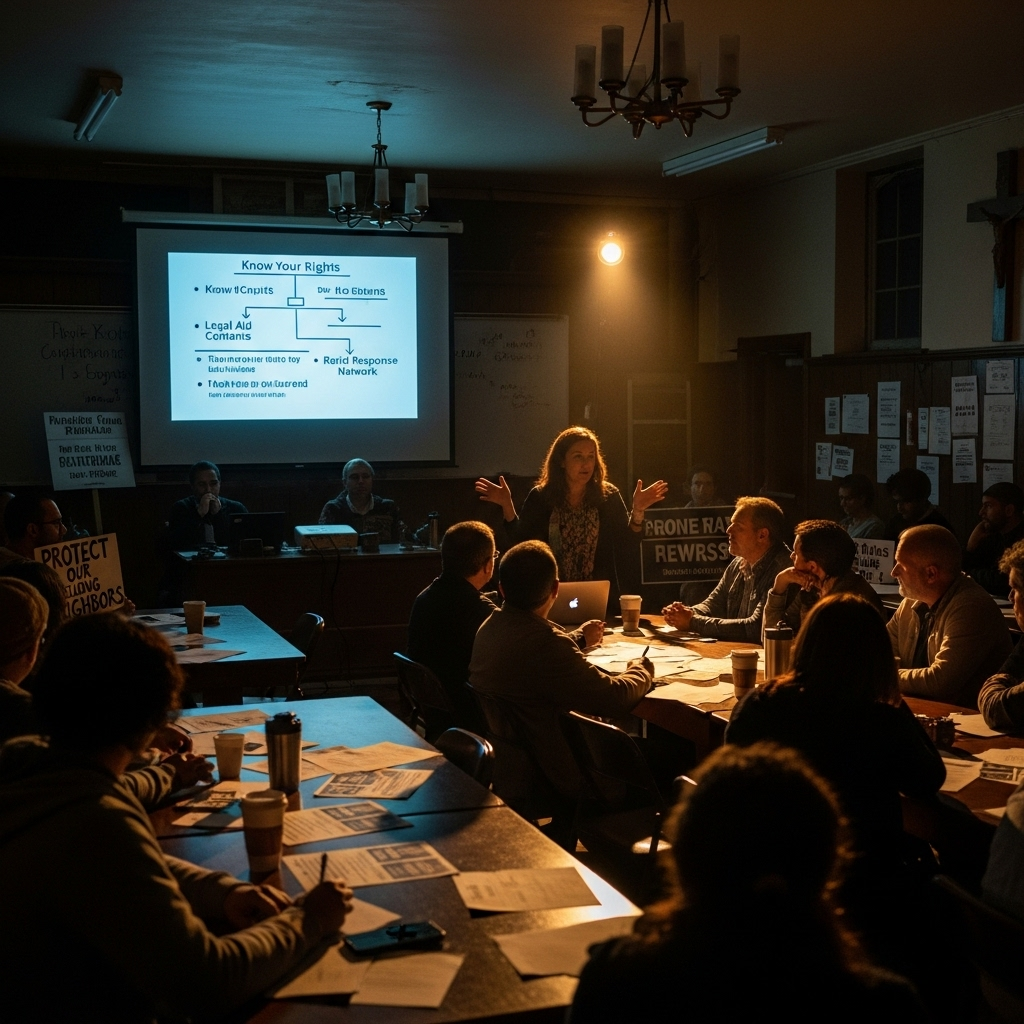
“We are putting ICE on notice,” said a fictional spokesperson for the IIRC in a press release. “We know Director Thorne’s playbook. We are activating our community alert networks, expanding our ‘Know Your Rights’ trainings, and preparing our legal response teams. Chicago will not be another Los Angeles. We will protect our neighbors.”
This proactive stance includes workshops to educate residents on what to do during an encounter with ICE, including the right to remain silent and the right to not open their doors without a warrant signed by a judge. The community’s resolve is strong, born from decades of organizing, but the psychological toll of a heightened threat is undeniable. Business owners are nervous, and families are discussing emergency plans in case a member is detained.
What to Expect: Potential Changes in ICE Tactics
Based on Thorne’s operational history, Chicago could see several tactical shifts in the coming months. These may include:
- Increased Workplace Audits: A surge in I-9 audits, where employers must prove the legal work authorization of their employees. This can lead to “silent raids” that result in mass firings and subsequent arrests.
- Pre-dawn Residential Operations: Coordinated operations in residential neighborhoods, a tactic used to great effect in Los Angeles, designed to apprehend individuals before they leave for work.
- Visible Public Presence: An increase in visible ICE vehicles and agents in community hubs, a tactic aimed at creating a deterrent effect through fear and intimidation.
The impact of these potential changes is immense. Beyond the individuals who may be detained and deported, such aggressive tactics can have a chilling effect on the entire community. People may become afraid to go to work, take their children to school, or seek medical care. The economic and social fabric of entire neighborhoods is at stake. For more information, see our guide on How to Handle an ICE Encounter.
Ultimately, the arrival of Marcus Thorne in Chicago represents more than just a bureaucratic shuffle. It signals that the focus shifts in a national immigration strategy, bringing the aggressive tactics of the past few years to a city that has defined itself by its opposition to them. The coming months will be a critical test of Chicago’s legal protections, its community resilience, and its very identity as a Welcoming City.
“`


