
Offensive Woes: 1 Giant Lineman Swings at Cowboys Player
The boiling point was reached Sunday afternoon at MetLife Stadium. In a game already defined by frustration and futility for the home team, the New York Giants’ deep-seated offensive woes manifested in a moment of raw, undisciplined anger. It wasn’t just a loss on the scoreboard; it was a loss of composure, encapsulated by a starting offensive lineman taking a swing at a Dallas Cowboys defender, earning an ejection and summarizing a disastrous day for the Big Blue offense.
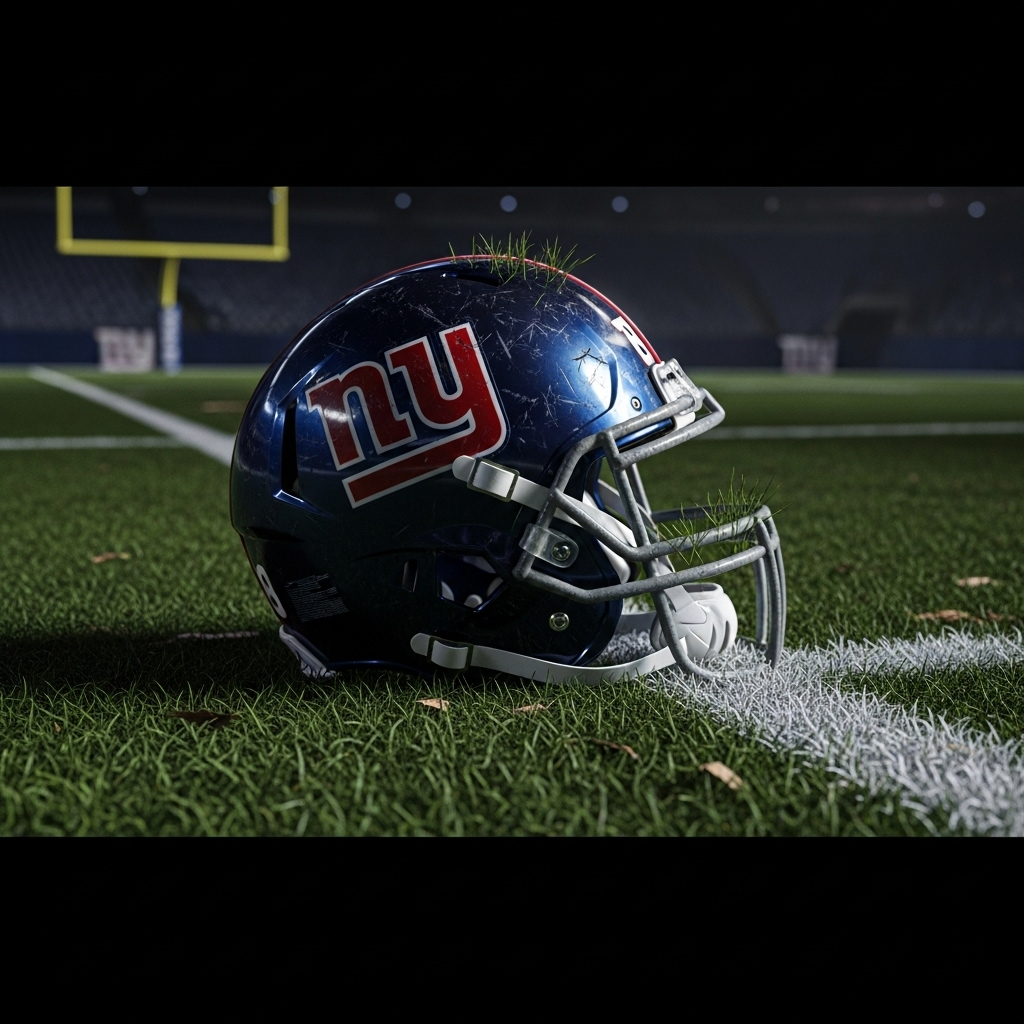
The Flashpoint: Tension Boils Over
The incident occurred late in the third quarter with the Giants trailing 24-3. Quarterback Daniel Jones was sacked for the fifth time, a takedown orchestrated by the relentless pressure from the Cowboys’ front seven. As players began to untangle from the pile, Giants left guard Mark Schofield, who had been beaten on the play, rose to his feet and exchanged heated words with Cowboys defensive end Chauncey Golston.
The verbal sparring quickly escalated. Schofield, visibly incensed after a game of being physically dominated, shoved Golston. When Golston retaliated with a shove of his own, Schofield lost his cool completely. He threw a right-handed swing that appeared to connect with the side of Golston’s helmet. Flags immediately flew from every direction, and officials converged to separate the scrum that had formed.
There was no debate. Schofield was assessed a 15-yard penalty for unnecessary roughness and was promptly ejected from the game. As he jogged off the field to a cascade of boos from the home crowd, his actions served as a physical representation of the Giants’ complete inability to compete. It was a moment of surrender, a sign that the pressure applied by the Cowboys had finally cracked the foundation of the Giants’ discipline.
A Symptom of Deeper Offensive Woes
While Schofield’s swing will dominate the headlines, it is merely a symptom of a much larger disease: the team’s crippling offensive woes. Throughout the game, the Giants’ offense was stagnant, predictable, and utterly ineffective. The running game, once a supposed strength, was held to a meager 47 yards. Third-down conversions were nearly non-existent, with the team going a dismal 1-for-11.
The pressure on the quarterback was suffocating. Jones spent most of the afternoon running for his life, unable to set his feet or get through his progressions. This wasn’t a one-game anomaly; it’s a trend that has plagued the team all season. The offense has struggled to find any rhythm, leading to short drives that exhaust their own defense and fail to put points on the board. The frustration that boiled over in Schofield was undoubtedly shared by every player on that side of the ball.
An offense that cannot protect its quarterback or establish a run game has no chance of succeeding in the NFL. These fundamental failures are the root cause of all other issues, from stalled drives to the kind of on-field meltdown we witnessed Sunday. The team is currently ranked 31st in the league in sacks allowed, a statistic that tells the entire story of their struggles.
A Closer Look at the Porous Offensive Line
To understand the Giants’ broader offensive problems, one must first look at the unit responsible for protecting the quarterback and paving the way for the run: the offensive line. For weeks, the line has been a liability. A combination of injuries, inconsistent play, and an inability to handle complex blitz packages has left them vulnerable.
Schofield’s frustration likely stemmed from being part of a unit that was comprehensively outmatched. The Cowboys’ defense utilized stunts and twists that left the Giants’ linemen looking confused and a step behind all game. Communication appeared to be a significant issue, with defenders frequently coming through unblocked. This constant pressure not only leads to sacks but also forces the quarterback into rushed, inaccurate throws, disrupting the entire timing of the passing game.
These issues have a cascading effect. When the pass protection is poor, it impacts the quarterback’s performance and confidence. When the run blocking is ineffective, the offense becomes one-dimensional and predictable. Fixing the Giants’ offense starts and ends in the trenches. Until this unit can play with cohesion and competence, the offensive woes will persist.
The Cowboys’ Dominant Defense: Fueling the Fire
Credit must also be given where it is due. The New York Giants’ failures were amplified by the Dallas Cowboys’ sheer dominance on defense. Defensive coordinator Dan Quinn’s unit came into the game with a clear plan: overwhelm the Giants’ weak offensive line and force bad decisions. They executed it to perfection.
Superstar linebacker Micah Parsons was a wrecking ball, recording two sacks and generating pressure on nearly every passing down. But the pressure was widespread, with multiple players contributing to the chaos. The Cowboys’ defensive front demonstrated a superior blend of speed, power, and technique that the Giants’ line simply had no answer for. For more info on their roster, visit the Dallas Cowboys’ official NFL page.
This relentless assault is designed to do more than just get sacks; it’s designed to mentally break an opponent. By the third quarter, it was clear the Cowboys had accomplished their mission. The constant physical punishment and inability to sustain drives led directly to the mental lapse from Schofield. Dallas didn’t just win on the scoreboard; they won the psychological battle, too.

Moving Forward: Can the Giants Find a Solution?
The aftermath of this embarrassing loss and on-field altercation leaves the Giants at a crossroads. Head Coach Brian Daboll now faces the dual challenge of addressing a breakdown in discipline and fixing a broken offense. Schofield will almost certainly face a fine, and potentially a suspension, from the league or the team.
But a personnel change at left guard won’t solve the core problem. The coaching staff must re-evaluate everything, from their blocking schemes to their play-calling. Can they simplify the offense to help the line? Can they use more quick passes and screens to neutralize the pass rush? These are the urgent questions that need answers before their next game.
This incident could serve as a rock-bottom moment that forces introspection and change. Or, it could be a sign of a team beginning to fracture under the weight of its own failures. For the sake of the players, the coaches, and the fanbase, the organization must hope it’s the former. The path forward is difficult, but it must begin with a complete and honest assessment of the offensive woes that led to Sunday’s meltdown.
“`


