
Public’s ‘Disconnect’: 3 Points from Justice Barrett
In an era of intense political polarization, the Supreme Court of the United States often finds itself at the center of a contentious public square. Speaking at a recent judicial conference, Justice Amy Coney Barrett addressed this issue head-on, offering a candid assessment of what she termed the public’s ‘disconnect’ from the institution she serves. This growing chasm, she suggested, isn’t merely about controversial decisions but stems from a fundamental misunderstanding of the Court’s purpose and process. Her remarks highlight a crucial challenge to the judiciary’s legitimacy in the 21st century.
Justice Barrett’s analysis can be distilled into three core observations that help explain why so many Americans feel alienated from the nation’s highest court. By exploring these points, we can gain a clearer understanding of the forces shaping public opinion and the intricate role of the judiciary in a democracy.
1. Judicial Philosophy vs. Policy Preference
The first and perhaps most critical point Justice Barrett raised is the public’s tendency to view Supreme Court decisions through the lens of partisan politics. Many people, she argued, see judges as “politicians in robes,” expecting them to deliver specific policy outcomes that align with their own preferences. This perspective, while understandable in our hyper-politicized climate, fundamentally misinterprets the role of a justice.
At the heart of this issue is the distinction between judicial philosophy and personal belief. Justices like Barrett adhere to methodologies such as textualism and originalism. This means they strive to interpret the Constitution and statutes based on their original text and the meaning understood at the time they were enacted. The goal, from this perspective, is to apply the law as it was written, not to update it to reflect contemporary values or achieve a desired social outcome.
For example, a decision on environmental regulations isn’t about whether a justice personally supports climate action; it’s about whether the text of the Clean Air Act grants a specific federal agency the authority it claims. As Barrett noted, “Our job is to interpret and apply the law… not to decide what the best policy for the country would be.”
The public’s ‘disconnect’ widens when a ruling conflicts with popular opinion or a political party’s platform. The outcome is often framed as a political loss rather than a legal conclusion. This conflation is a major source of frustration, as citizens may feel the Court is out of step with the nation, when in fact, the justices may see themselves as faithfully adhering to their constitutional duty, which is distinct from reflecting the popular will. For a deeper dive into these concepts, scholarly resources like the Cornell Law School’s Legal Information Institute provide excellent explanations.
2. Media Narratives and the Public’s ‘Disconnect’
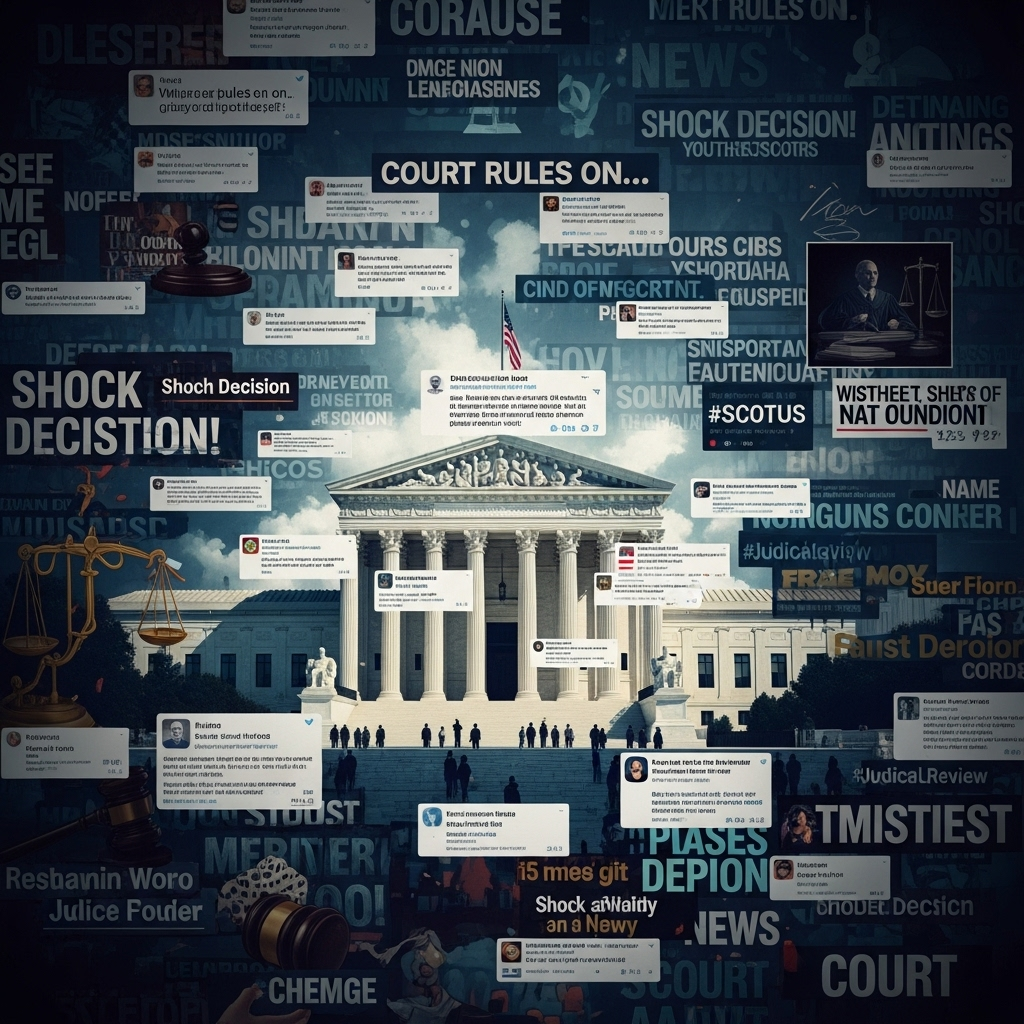
Building on her first point, Justice Barrett identified modern media consumption habits as a powerful accelerator of the public’s ‘disconnect’. In a 24/7 news cycle driven by clicks and engagement, complex legal reasoning is often boiled down to simplistic, conflict-oriented headlines. A 90-page majority opinion, complete with intricate statutory analysis and historical context, might be reduced to a single push notification: “Court Strikes Down X” or “Justices Uphold Y.”
This “soundbite culture,” as some have called it, strips away the nuance essential to understanding judicial decisions. It frames every case as a battle between two clearly defined sides, with the justices picking a winner. Political commentators and cable news panels then amplify this narrative, slotting justices into predictable “liberal” and “conservative” blocs.
Barrett suggested that this coverage encourages the public to “read the box score” rather than understand the game. People know who “won” or “lost,” but they have little insight into the legal principles that led to the result. This creates an environment where confirmation bias thrives; if a ruling aligns with one’s politics, the Court is wise, but if it doesn’t, the institution is suddenly broken or illegitimate.
This dynamic places the Court in an impossible position. As an institution designed for deliberate, nuanced reasoning, it is ill-equipped to compete in an arena that rewards speed and simplicity. The quiet, methodical work of legal interpretation is no match for a viral social media post decrying a decision. For more on this, check out our related article on How Social Media Shapes Legal Perceptions.
3. The Perceived Opacity of Court Procedures
Finally, Justice Barrett acknowledged that some of the public’s ‘disconnect’ is institutional. The Supreme Court is, by design, a reserved and somewhat opaque body. Its traditions and procedures can seem arcane and distant to the average citizen, contributing to a sense of an “ivory tower” judiciary that is unaccountable to the people it serves.
Key factors contributing to this perception include:
- No Cameras in the Courtroom: While audio of oral arguments is now readily available, the prohibition on cameras means the public cannot see the back-and-forth between justices and lawyers, a key part of the process.
- Complex Written Opinions: Judicial opinions are written for a legal audience and are filled with jargon, citations, and complex structural arguments that can be impenetrable to non-lawyers.
- Infrequent Public Comment: Justices rarely give interviews or public speeches, adhering to a tradition of letting their written opinions speak for themselves.
While these traditions are rooted in the desire to maintain judicial independence and decorum, they can inadvertently fuel suspicion and misunderstanding. In an age of radical transparency, the Court’s reluctance to “open up” can be misinterpreted as hiding something. This procedural distance makes it harder for the public to grasp the rigorous, non-political nature of the work justices undertake, reinforcing the idea that decisions are simply political decrees handed down from on high.
The challenge, as Barrett seems to see it, is balancing the need for institutional gravity with the public’s legitimate desire for understanding and access. Ignoring this part of the public’s ‘disconnect’ could be perilous for the Court’s long-term standing.
Bridging the Gap: What’s Next?
Justice Barrett’s reflections offer a compelling framework for understanding the public’s ‘disconnect’ from the Supreme Court. It’s a multifaceted problem born from a clash between judicial principle and political expectation, amplified by media narratives, and cemented by institutional tradition.
So, what can be done? The solution likely requires effort from all sides. The public and the media have a responsibility to seek a deeper understanding of the Court’s role, moving beyond political box scores. Educational initiatives and more nuanced reporting could help demystify judicial philosophies and the deliberative process.
Simultaneously, the Court itself may need to continue exploring ways to improve transparency without compromising its integrity. The recent adoption of a formal code of conduct is a step in this direction, but debates over cameras, clearer communication, and civic outreach will undoubtedly continue. Ultimately, bridging the gap is essential for the health of American democracy, as the Court’s authority rests not on force, but on the public’s sustained belief in its legitimacy.


