
‘block everything’ protests: Over 300 Arrested in France
Major cities across France were brought to a standstill on Wednesday as widespread demonstrations, dubbed the ‘block everything’ protests, saw activists shutting down critical infrastructure. The French Interior Ministry has confirmed that over 300 individuals have been arrested in connection with the disruptive actions, which have targeted highways, fuel depots, and government buildings in a powerful display of public discontent.
The protests, known locally as “Tout Bloquer,” represent a significant escalation of tensions over the rising cost of living, controversial environmental policies, and a general sense of economic precarity. This movement echoes previous waves of protest in the country but appears more coordinated in its goal of causing maximum economic disruption to force a government response.
Article Contents
What Sparked the “Tout Bloquer” Movement?
The catalyst for the current ‘block everything’ protests is a combination of long-simmering grievances and recent government actions. At the forefront is the continued pressure of inflation, which has seen the price of essential goods, from food to energy, soar over the past 18 months. For many working-class families, the financial strain has become unbearable.
A recent “eco-tax” on commercial vehicles, intended to accelerate the country’s green transition, has been cited by many protesters as the final straw. Lorry drivers and agricultural workers argue the tax unfairly penalizes them without providing viable, affordable alternatives. This has galvanized various sectors to unite under a common banner of opposition.
While the movement is decentralized, it draws inspiration from the “Gilets Jaunes” (Yellow Vests) protests that began in late 2018. However, organizers of “Tout Bloquer” have learned from the past, focusing on precise, economically painful blockades rather than just large-scale marches. The goal is simple: if the economy can’t function, the government will have to listen.
Scenes of Disruption Across the Nation
From the early hours of Wednesday morning, reports flooded in of coordinated blockades. On the A1 motorway, the main artery connecting Paris to the north, protesters used vehicles and makeshift barricades to halt traffic in both directions. Similar scenes played out near major cities like Marseille, Lyon, and Bordeaux, where key roundabouts and access roads were occupied.
In the port city of Le Havre, access to major fuel depots was blocked, raising concerns about potential fuel shortages if the protests continue. Demonstrators, a mix of farmers, truckers, students, and union members, expressed a mix of anger and determination.
“We have been ignored for too long,” said one protester in Lyon, who identified himself as a small business owner. “They talk about climate change, but they expect us to pay the price while large corporations get tax breaks. We are here to block everything because everything is broken.”
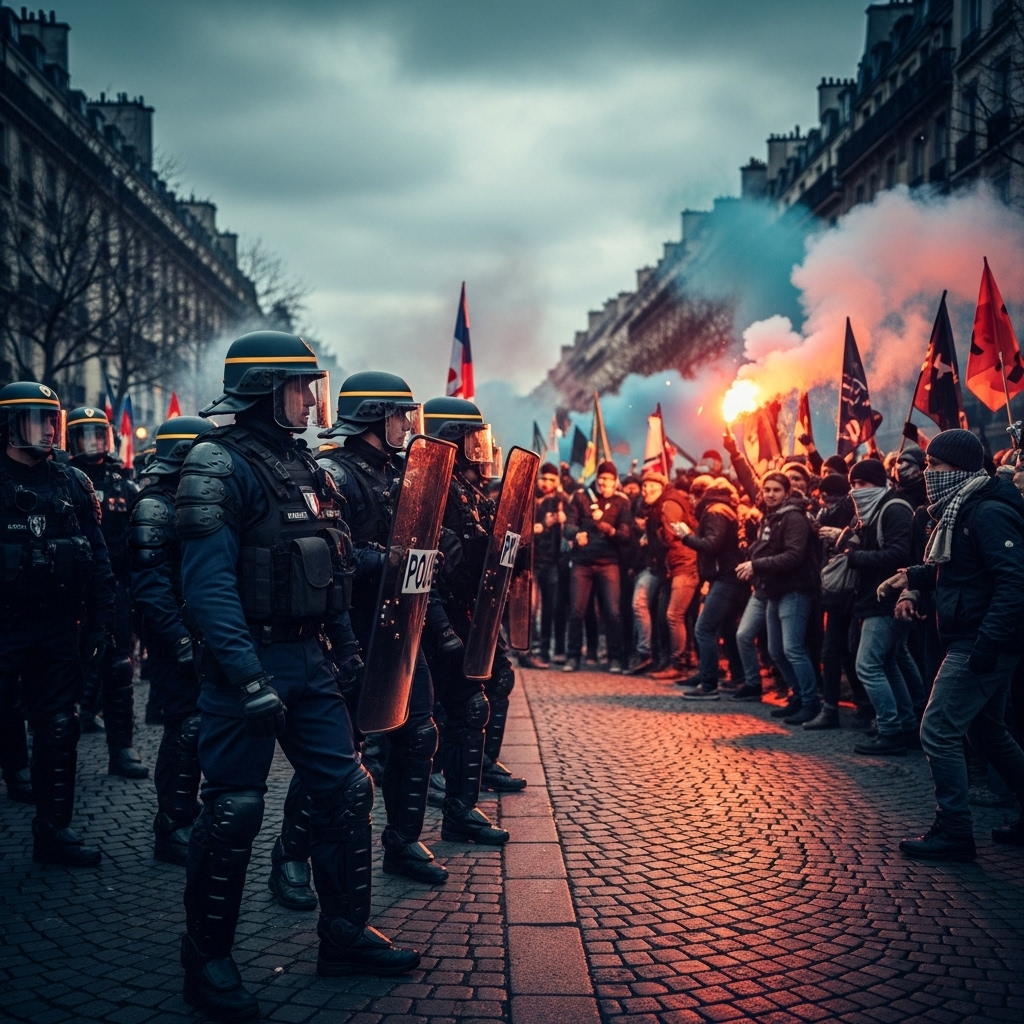
The atmosphere in many locations was tense but largely non-violent, though isolated clashes with police were reported in the suburbs of Paris. The scale of the coordination suggests a sophisticated level of organization, likely facilitated through encrypted messaging apps and social media groups.
The Government’s Firm Response
The French government has taken a hardline stance against the disruptions. Interior Minister Gérald Darmanin appeared on television to condemn the actions, stating, “The right to protest is a constitutional guarantee, but the right to block, to vandalize, and to prevent people from working is not. We will show zero tolerance.”
Thousands of gendarmes and CRS riot police were deployed nationwide to dismantle the blockades. The more than 300 arrests were made on charges including obstruction of traffic, endangerment of others, and refusal to disperse. The government’s strategy is to quickly restore order and deter further actions by demonstrating a strong police presence.
President Emmanuel Macron’s office has yet to issue a direct statement, but sources from the Élysée Palace suggest the government is unwilling to concede to demands made “under duress.” This sets the stage for a prolonged standoff between the state and a determined protest movement.

What are the ‘block everything’ protests Demanding?
The demands of the ‘block everything’ protests are broad, reflecting the diverse coalition of groups involved. While there is no single leader or manifesto, a clear set of core objectives has emerged from banners and local organizers:
- Immediate withdrawal of the new eco-tax on commercial and agricultural vehicles.
- A significant increase in the national minimum wage (SMIC) to combat inflation.
- The implementation of price caps on essential goods, particularly fuel, electricity, and basic foodstuffs.
- A re-evaluation of pension reforms and a halt to any further increases in the retirement age.
- Greater public consultation on environmental policies to ensure a “just transition” that doesn’t disproportionately burden lower and middle-income citizens.
These demands highlight a deep-seated frustration with economic policies perceived as favoring the wealthy and large corporations. For more details on the political background, see our analysis on France’s current political landscape.
Economic Fallout and Public Reaction
The economic impact of just one day of protests has been significant. The national federation of road transporters reported that the blockades have cost the industry tens of millions of euros in delays and lost contracts. Retail and manufacturing sectors are also bracing for supply chain disruptions if the actions persist.
Public opinion remains divided. A recent poll indicated that while nearly 65% of the public sympathizes with the protesters’ grievances, only 40% support the “block everything” method. This “sympathy-but-not-support” sentiment is common in France, where the public often understands the anger behind protests while simultaneously being frustrated by the inconvenience they cause.
“I can’t get to work, and I’ll lose a day’s pay,” a commuter in Paris told a local radio station. “I understand why they are angry—we are all angry—but blocking everyone doesn’t solve the problem.”

What Comes Next for France?
Protest organizers have vowed that this is just the beginning. Calls are circulating online for another, even larger, day of action next week. The key question is whether the movement can sustain its momentum in the face of a firm government response and potentially waning public support.
The government’s challenge is to restore order without appearing to be deaf to the genuine economic pain felt by a large portion of the population. A failure to engage in dialogue could further entrench the opposition and lead to an even greater escalation. For official statements, the public can refer to the French Ministry of the Interior website.
As France braces for more potential disruption, the ‘block everything’ protests have already succeeded in one of their primary goals: forcing the entire nation to confront the deep social and economic fractures running through it. The coming days will be critical in determining whether this confrontation leads to conflict or compromise.
“`


