
‘Block Everything’ Protests: French Police Arrest 100s
Major cities and transport arteries across France were brought to a standstill on Thursday as the latest wave of ‘block everything’ protests saw coordinated action from farmers, truckers, and other union groups. In response to the widespread disruption, French authorities launched a significant security operation, resulting in the arrests of hundreds of individuals throughout the country.
The movement, known colloquially as “Opération Tout Bloquer,” aims to paralyze the nation’s economy to force government concessions on a controversial new environmental tax. The day of action created chaos on highways, at major ports, and around key distribution centers, testing the resolve of President Emmanuel Macron’s government.
Contents
What Sparked the ‘Block Everything’ Protests?
At the heart of the unrest is the government’s newly proposed “Agricultural Sustainability Levy.” Proponents argue the tax is a necessary step to meet France’s climate goals as outlined in the Paris Agreement. However, opponents claim it disproportionately burdens the agricultural and logistics sectors, which are already struggling with high fuel costs and international competition.
Gérard Leduc, a farmers’ union representative from Normandy, spoke to reporters from a blockade on the A13 motorway. “This is not a choice; it is a necessity,” he stated. “They call it a ‘sustainability levy,’ but for us, it is a ‘bankruptcy levy.’ We are being asked to pay for a green transition that will put us out of business. We will block everything until this bill is withdrawn.”
This sentiment has been echoed by trucking associations, who have joined the ‘block everything’ protests in solidarity. They cite rising operational costs and feel the government is out of touch with the realities of their industries. The movement has drawn comparisons to the “Gilets Jaunes” (Yellow Vests) protests that rocked France years prior, highlighting a deep-seated rural and working-class discontent.
A Coordinated Day of Disruption
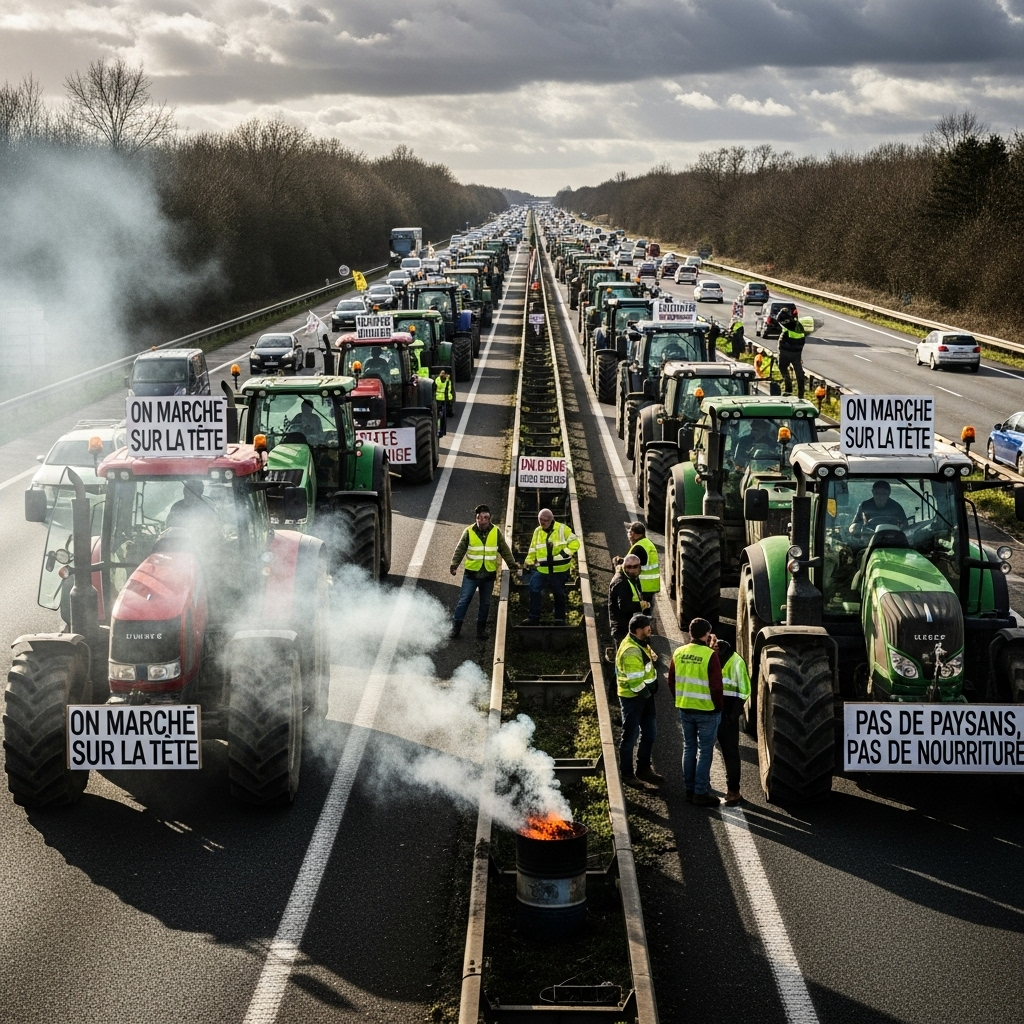
The protests were meticulously planned, utilizing encrypted messaging apps to coordinate “go-slow” operations and strategic blockades. Major highways around Paris, Lyon, and Marseille were targeted, with tractors and trucks forming rolling barricades from the early morning hours. This created miles-long traffic jams, affecting commuters and supply chains alike.
Key infrastructure points were also a primary focus. Access roads to the Port of Le Havre and the Channel Tunnel entrance near Calais were severely restricted, halting the flow of goods to and from the UK. Protestors also set up blockades around major supermarket distribution hubs, threatening to create food shortages if the action continues.
The methods used in the ‘block everything’ protests are designed for maximum economic impact. By targeting the arteries of commerce, demonstrators hope to apply pressure that the government cannot ignore. “If our goods don’t move, the country doesn’t run,” one protestor’s sign read, summing up the movement’s core strategy.
The Official Response: A Firm Stance
The government’s response was swift and firm. Interior Minister Gérald Darmanin announced that over 15,000 police and gendarmes had been mobilized to “restore public order” and “guarantee the freedom of movement for all citizens.” He condemned the blockades, stating that while the right to protest is protected, the “right to paralyze the country is not.”
Throughout the day, police forces moved in to dismantle the more disruptive barricades. Clashes were reported in several locations, with police using tear gas to disperse crowds who resisted their advance. The Interior Ministry confirmed that as of Thursday evening, at least 420 arrests had been made for offenses including obstructing traffic, resisting arrest, and destruction of public property. For more on European political responses, see reports from sources like Reuters Europe.
President Macron, speaking from a summit in Brussels, reiterated that the government would not be swayed by “pressure from the street.” He insisted that the environmental transition was “non-negotiable” but stated his willingness to “open dialogue” on how to support the affected sectors through the transition, a promise many protestors feel is too little, too late.
Economic Impact and Public Reaction
The economic cost of a single day of such widespread disruption is estimated to be in the hundreds of millions of euros. The MEDEF, France’s largest employer federation, warned that prolonged action could have a devastating impact on businesses already weakened by post-pandemic inflation. Retail, manufacturing, and export sectors are particularly vulnerable.
Public opinion, a critical factor in the longevity of such movements, remains divided. Polling conducted this week shows a near 50/50 split. Many citizens express sympathy for the economic plight of the farmers and truckers, while others are frustrated by the massive inconvenience and disruption to their daily lives. “I understand their anger, I really do,” one Parisian commuter told a local news channel. “But I have to get to work. My own livelihood is at stake, too.”
As the sun set on a tense day, many blockades began to disperse, with protest leaders vowing to return if their demands are not met. The government now faces a delicate balancing act: maintaining public order and its climate agenda without further alienating a significant and mobilized portion of its population. The ‘block everything’ protests have thrown down a serious challenge, and the coming days will be crucial in determining whether a resolution can be found or if France is heading for a prolonged period of social unrest. More analysis on this can be found in our political analysis section.
“`


