
‘block everything’ protests: French police arrest 200+
Tensions have escalated across France as the nationwide ‘block everything’ protests led to significant clashes with law enforcement, resulting in the arrest of over 200 individuals. The coordinated demonstrations, aimed at paralyzing the country’s economic infrastructure, have brought major cities to a standstill and presented a formidable challenge to President Macron’s government. Protesters have established blockades on major highways, ports, and distribution centers, demanding immediate policy changes on fuel costs and a new “eco-tax” proposal.
The movement, which gained momentum through social media, represents a broad coalition of citizens, including truckers, farmers, and students, all expressing deep-seated frustration with the rising cost of living and perceived government indifference. This article breaks down the causes, the scale of the disruption, and the potential consequences of this unfolding crisis.
What Sparked the Latest ‘Block Everything’ Protests?
The immediate catalyst for this recent wave of ‘block everything’ protests was the government’s announcement of a new “Green Contribution” tax. Set to take effect next month, the tax would add a significant surcharge to diesel and gasoline, a measure the government claims is essential for funding its climate transition goals. However, for many citizens already struggling with inflation, this was the final straw.
Organizers argue that the tax disproportionately affects lower and middle-income households, particularly those in rural areas who rely on personal vehicles for work and daily life. They contend that while they are not against environmental action, the financial burden is being placed on those least able to bear it, while large corporations receive exemptions.
The “block everything” (or “tout bloquer”) tactic is a direct evolution from previous protest movements in France. It involves using vehicles, burning tires, and human chains to obstruct critical infrastructure. The goal is not just to be seen and heard, but to inflict immediate and tangible economic pain, forcing the government to the negotiating table. This strategy targets the arteries of the French economy: highways, oil refineries, and major ports like Marseille and Le Havre.
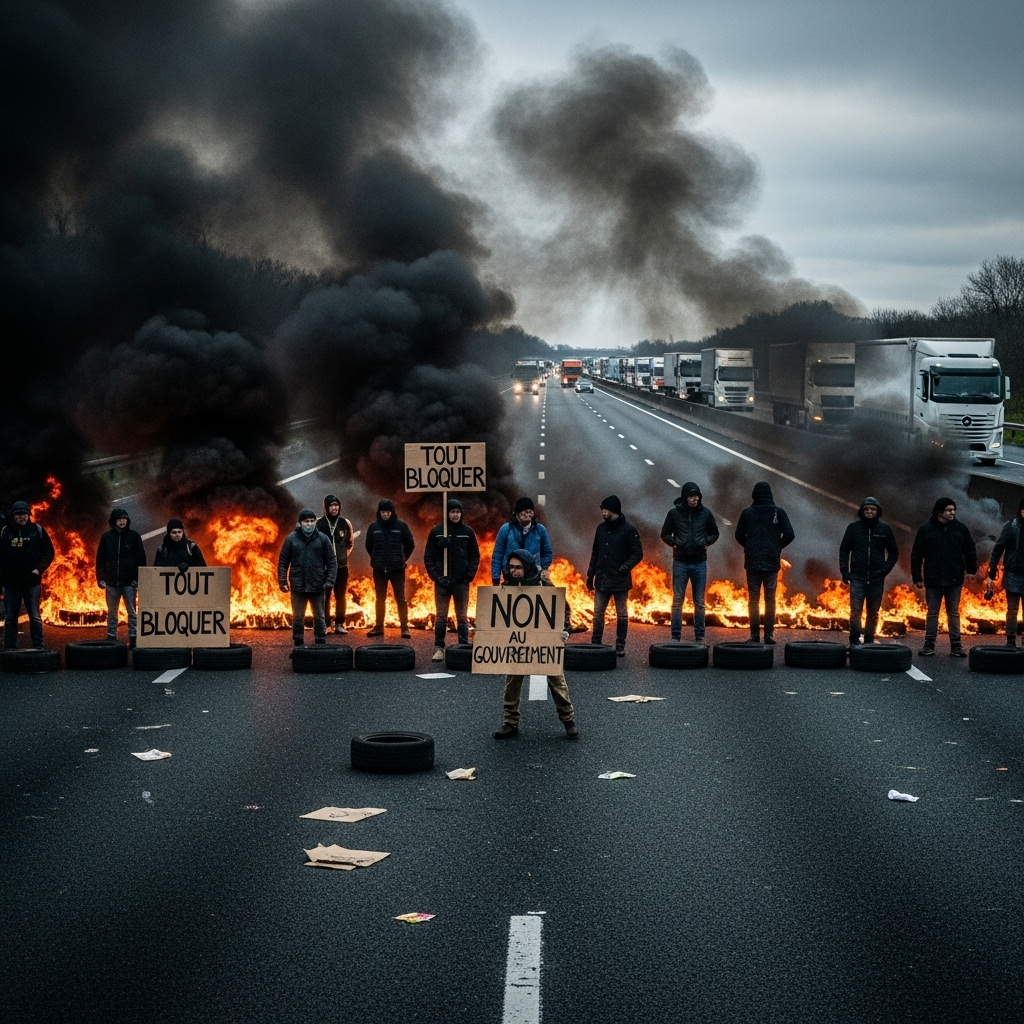
A Nation on Edge: The Scale of the Demonstrations
The scale of the ‘block everything’ protests has been staggering, spreading far beyond the capital. According to the Ministry of the Interior, over 800 separate blockade points were reported across the country at the peak of the demonstrations. Major highways, including the A1 connecting Paris to Lille and the A7 leading south to Lyon and Marseille, were rendered impassable for hours.
In Paris, protesters attempted to blockade the Périphérique ring road, leading to chaotic scenes and confrontations with police. In Lyon, access to the main industrial park was completely cut off, while in Brittany, farmers used tractors to block access to supermarket distribution centers, raising concerns about food shortages if the protests continue.
The disruption to daily life has been immense. Millions of commuters faced gridlock, many schools reported high rates of teacher and student absenteeism, and businesses lamented the impact on supply chains. The National Federation of Road Haulage reported that the blockades were costing the logistics industry an estimated €50 million per day. This widespread impact is a core part of the protesters’ strategy to maximize pressure on officials.
The Government’s Response: Clashes and Arrests
The government’s response has been firm. Interior Minister Gérald Darmanin stated that while the right to protest is protected, “the right to block, to loot, and to endanger the lives of others is not.” He authorized a major police mobilization, deploying over 45,000 officers and gendarmes nationwide to dismantle the barricades.
Clashes were reported in several cities. Police used tear gas and water cannons to disperse crowds in Toulouse and Nantes after protesters allegedly threw projectiles. The Ministry of the Interior confirmed that 209 arrests have been made for offenses including destruction of public property, violence against law enforcement, and obstructing traffic. Dozens of police officers and protesters have reportedly sustained minor injuries.
President Macron has yet to comment directly on this latest flare-up but is under increasing pressure from both his political opponents and allies to find a solution. For more context on the policies leading to this, see our related article: French Economic Reforms Explained.

Voices from the Barricades: Who Are the Protesters?
The ‘block everything’ protests are characterized by their diverse participants, drawn together by a shared sense of economic despair. Unlike traditional union-led movements, this is a grassroots phenomenon with no single leader.
On a blockade outside Paris, a truck driver named Jean-Luc explained his position. “I drive 10 hours a day. This new tax means I will either have to work more for the same pay or go out of business. They are killing us from their offices in Paris. We have to block everything so they finally listen.”
Nearby, a university student named Chloé held a sign reading “No Future on a Dead Planet, No Present on an Empty Stomach.” She added, “We need climate action, but not this way. Tax the private jets, tax the polluter corporations. Don’t tax the people trying to get to work or feed their families. It’s about justice.”
This sentiment is echoed by farmers who feel squeezed by international trade agreements and rising operational costs. Their participation highlights a deep rural-urban divide and a feeling of being left behind by national policy.
Economic Fallout and Future Implications of the ‘Block Everything’ Protests
The economic repercussions of the ‘block everything’ protests are already being felt across multiple sectors. Beyond the immediate losses in logistics and transport, retailers are reporting sharp drops in foot traffic and sales. The French Commerce Federation has warned of impending stock shortages for certain goods if the blockades on distribution centers are not lifted swiftly.
Furthermore, the ‘block everything’ protests threaten France’s reputation as a stable place for investment and tourism, especially coming so soon after other social unrest. The Finance Ministry is closely monitoring the situation, with an official telling Reuters that “every day the blockades continue, the damage to our national GDP grows significantly.”
The political implications are equally severe. The government faces a difficult choice: back down and appear weak, potentially encouraging more protests in the future, or stand firm and risk a prolonged and economically devastating conflict. The ‘block everything’ protests have become a major test of President Macron’s leadership and his ability to navigate social and economic crises.

Conclusion: An Uncertain Path Forward
With over 200 arrests and no sign of de-escalation from either side, France is navigating a period of intense uncertainty. The ‘block everything’ protests have successfully demonstrated the power of a decentralized, grassroots movement to cause massive disruption and challenge government authority.
The core issues of economic inequality and the perceived unfairness of climate policies are not going away. How the government responds in the coming days will be critical. A compromise could quell the immediate unrest but may set a new precedent for how policy is debated in France. A continued hardline stance could lead to further escalation and deeper social fractures.
For now, the nation remains on edge, with highways blocked, the economy strained, and the path to resolution far from clear. The world is watching to see if France can find a way out of the impasse created by the powerful and disruptive ‘block everything’ protests.
“`


