
Violent Crime in Chicago: 5 Myths vs. the Real Data
Chicago. The name itself often conjures a whirlwind of images: deep-dish pizza, stunning architecture, and, for many, headlines about crime. The city’s struggle with violent crime has become a national talking point, frequently simplified into soundbites that fuel fear and misunderstanding. But what does the actual data say? When we move past the sensationalism, a more nuanced and complex picture emerges.
The conversation surrounding public safety is too important to be guided by myths. To foster real solutions, we must ground our understanding in facts. This article will tackle five of the most persistent myths about violent crime in Chicago, comparing them directly with publicly available data to reveal the truth.
Myth 1: Chicago is the “Murder Capital” of the United States.
The Reality: Chicago has a high number of homicides, but not the highest homicide rate.
This is perhaps the most pervasive myth. Because Chicago is the third-largest city in the U.S., its raw number of homicides is often higher than that of smaller cities. In any given year, the total number of murders can indeed be the highest in the nation. However, this statistic is misleading without context.
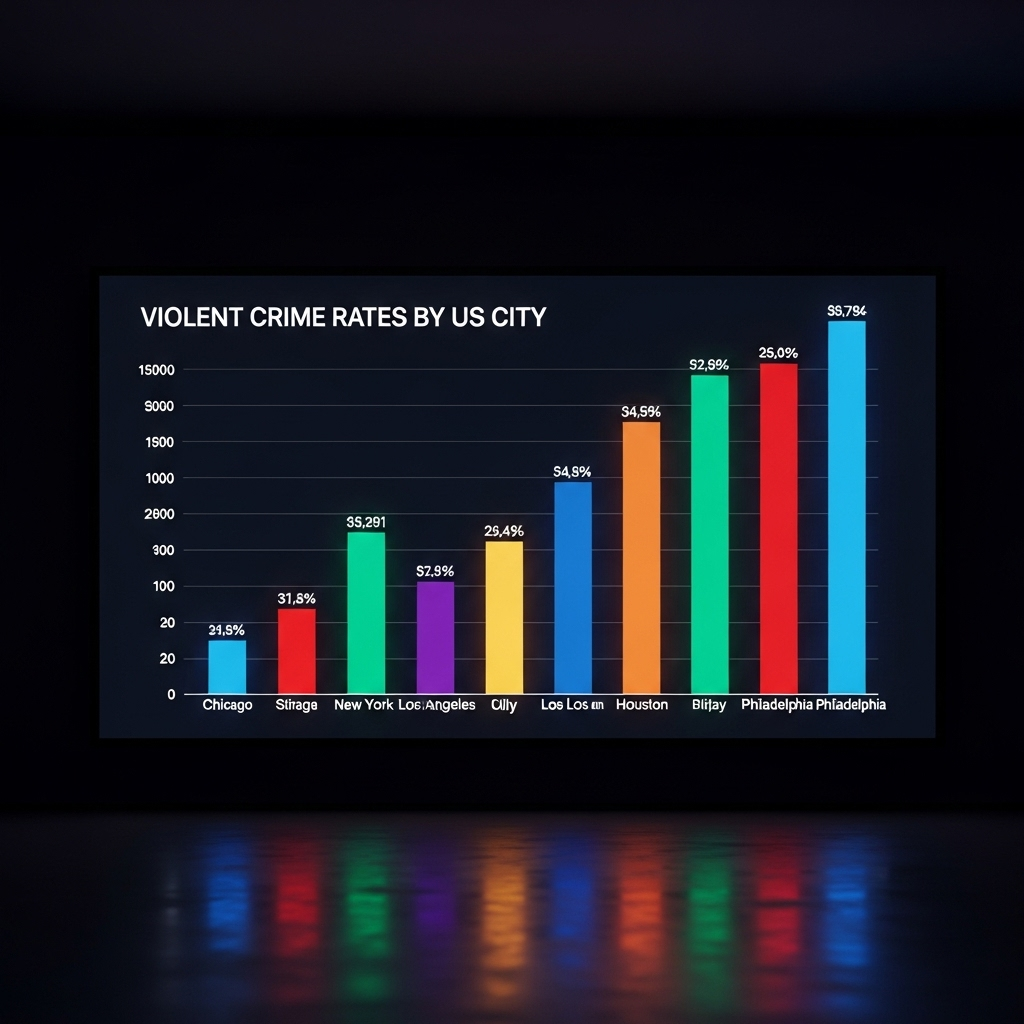
Criminologists and statisticians measure a city’s level of violence by its homicide rate—the number of murders per 100,000 residents. When you use this more accurate metric, Chicago is very rarely at the top of the list. Cities like St. Louis, Baltimore, Detroit, and New Orleans have consistently posted higher homicide rates for years.
For example, a year where Chicago might have 600 homicides in a city of 2.7 million people results in a rate of about 22 per 100,000. In the same year, a city like St. Louis with 200 homicides and a population of under 300,000 would have a rate of over 66 per 100,000—three times higher. Focusing only on the raw number ignores the population size and inflates the perception of danger compared to other urban areas.
Myth 2: Random Violent Crime Makes the Entire City Unsafe.
The Reality: The majority of violent crime is hyper-concentrated in specific neighborhoods.
The narrative of random violence plaguing every street corner is another distortion. Data from the Chicago Police Department’s data portal clearly shows that violent crime is not evenly distributed across the city’s 77 community areas.
A disproportionately high percentage of incidents, particularly shootings and homicides, occurs in a handful of neighborhoods on the South and West Sides. These are often communities that have suffered from decades of systemic disinvestment, poverty, and segregation. Areas like Englewood, West Garfield Park, and Austin face challenges that are vastly different from what residents experience in neighborhoods like Lincoln Park, Lakeview, or the downtown Loop.
This is not to dismiss the seriousness of the violence but to specify where it is happening and why. The violence is rarely random. It is often retaliatory and linked to gang conflicts and personal disputes. For the average tourist visiting Millennium Park or a resident living on the North Side, the statistical risk of being a victim of violent crime is dramatically lower than the headlines suggest.
Myth 3: Violent Crime in Chicago Is Constantly Getting Worse.
The Reality: Violent crime has seen recent spikes but is significantly down from its historical peak.
It’s easy to believe crime is always on the rise, especially with media focusing on yearly increases. Chicago did experience a tragic and significant spike in homicides and shootings in 2020 and 2021, mirroring a trend seen in major cities across the country during the COVID-19 pandemic. However, looking at the long-term data provides crucial perspective.
Chicago’s peak year for homicides was 1992, with 943 murders. Throughout the late 1990s and 2000s, there was a steady and significant decline in violent crime. While the numbers have fluctuated since, they remain well below the levels seen in the early 90s. For instance, even after the recent spike, the homicide totals are still lower than what the city experienced for years during that earlier era.
Understanding this historical context is key. It shows that progress is possible and that recent setbacks, while serious, are not necessarily indicative of an irreversible, ever-worsening trend. The city has been safer before, and data-driven strategies can help reduce violence again.

Myth 4: Most of the Crime is Caused by People from Outside Chicago.
The Reality: Data shows that both victims and offenders are overwhelmingly residents of Chicago.
This myth often surfaces in political discourse, attempting to shift blame away from the city’s internal issues. However, police data consistently refutes this claim. The vast majority of those arrested for violent crime, as well as the victims of that crime, are residents of Chicago.
Furthermore, the data shows they are often residents of the same disinvested neighborhoods where the violence is concentrated. This is not a problem of “outsiders” coming into the city to cause trouble; it is a deeply internal issue rooted in cycles of poverty, trauma, and lack of opportunity within specific community areas. Blaming outsiders is a convenient deflection that hinders any real effort to address the root causes of violence, which our own analysis of community-based solutions has explored.
Myth 5: The Only Solution to Violent Crime is More Policing.
The Reality: Policing is one tool, but sustainable reduction in violence requires a multi-faceted approach.
While law enforcement plays a critical role in responding to and investigating crime, the idea that simply increasing police presence is a cure-all is not supported by evidence. The relationship between police numbers and crime rates is complex and often debated. What is clear is that policing alone cannot solve the underlying issues that drive violence.
Many of the most effective strategies for reducing violent crime are community-based and preventative. Organizations like the University of Chicago Crime Lab have studied and highlighted the impact of:
- Street outreach and violence interruption programs: These programs use credible messengers—often former gang members—to mediate conflicts before they turn deadly.
- Investment in education and job opportunities: Providing viable pathways to economic stability can offer an alternative to illicit activities.
- Cognitive Behavioral Therapy (CBT): Programs that help at-risk youth manage anger, trauma, and decision-making have shown remarkable success in reducing arrests.
- Environmental improvements: Simple changes like cleaning up vacant lots, improving street lighting, and creating community spaces can deter crime and build neighborhood pride.
Moving Beyond the Myths
The narrative surrounding violent crime in Chicago is often more myth than reality. By looking at the data, we see a story that is less about a city uniformly under siege and more about a targeted crisis in specific, long-neglected communities. The rates are lower than many other cities, the trends are not a simple upward climb, and the causes are internal and deeply rooted in socioeconomic factors.
Moving the needle on this issue requires us to move past the headlines. It demands a commitment to data-driven, community-focused strategies that address the root causes of violence. Only by trading fear for facts can we have an honest conversation and work toward building a safer Chicago for all its residents.


