
Downed Drones: 2 Incidents in Poland & Gaza Attack Claims
The skies are becoming an increasingly contested space, with recent events highlighting the growing threat and complexity of unmanned aerial vehicles (UAVs). Reports of downed drones have surged globally, and this week saw two separate incidents in Poland raising security alarms across NATO’s eastern flank, while militant groups in Gaza claimed a successful drone operation against Israeli targets. These events underscore the dual-use nature of drone technology and the challenges nations face in securing their airspace.
From sophisticated military reconnaissance to crude but effective explosive delivery systems, drones are reshaping modern conflict and national security. The incidents in Poland, a key NATO ally bordering Ukraine, are particularly concerning, while the claims from Gaza demonstrate the continued use of drones by non-state actors to project power and challenge technologically superior adversaries.
Unidentified Drone Downed in Southern Poland
Polish military authorities have confirmed that an unidentified military-style drone was brought down late Monday evening near the southeastern city of Zamość, less than 60 miles from the Ukrainian border. The Polish Armed Forces Operational Command stated that air defense systems tracked the UAV after it crossed into Polish airspace from the east. After the drone failed to respond to communication attempts, a decision was made to “neutralize the threat.”
While officials have remained tight-lipped about the exact method of interception, local sources reported hearing a loud explosion consistent with an air defense missile launch. The wreckage of the downed drone is now being analyzed by military experts to determine its origin, capabilities, and intent. “Every unauthorized intrusion into our airspace is treated with the utmost seriousness,” said a spokesperson for the Polish Ministry of National Defence. “Our forces are on high alert and have proven their capability to protect our skies.”
This incident is not the first of its kind. The ongoing war in Ukraine has led to several instances of stray munitions and drones crossing into neighboring territories, prompting a significant buildup of air defense capabilities along NATO’s eastern border. The primary concern is whether such intrusions are accidental spillovers from the conflict or deliberate provocations.
Mysterious Drone Grounded Near Warsaw
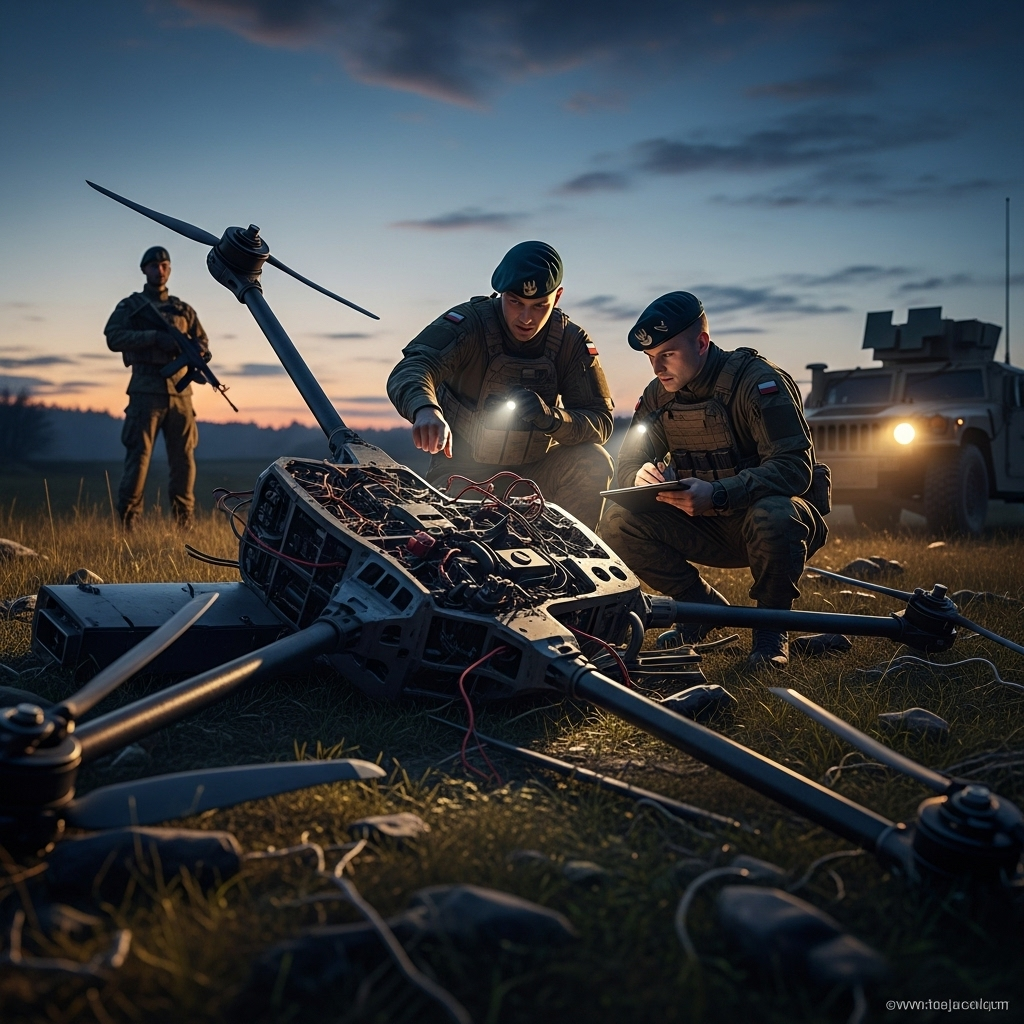
In a separate and seemingly unrelated event, a smaller, commercially modified drone was forcefully grounded near a critical energy infrastructure facility just outside of Warsaw early Tuesday morning. Security personnel at the facility detected the drone flying in a restricted zone and employed a counter-drone jamming system to disrupt its controls, causing it to land abruptly.
Unlike the military drone in the south, this UAV appeared to be a modified quadcopter, but it was carrying an unknown payload that is now under investigation by bomb disposal units. “The quick action of our security team prevented a potential threat to a vital national asset,” a statement from the facility operator read. This highlights a different but equally pressing issue: the potential for commercially available drones to be weaponized or used for espionage by state or non-state actors.
The investigation is focusing on tracing the drone’s operator. These two incidents of downed drones in Poland within 24 hours paint a stark picture of the multifaceted threats now present in European airspace.
Analyzing the Rise of Downed Drones in Eastern Europe
The proliferation of drones in the Ukrainian conflict has created a new reality for neighboring countries. Both Russia and Ukraine extensively use UAVs for reconnaissance, artillery spotting, and direct attacks. The consequence is a constant risk of drones—damaged, malfunctioning, or simply off-course—violating the airspace of countries like Poland, Romania, and Moldova.
NATO has responded by bolstering its Integrated Air and Missile Defence (IAMD) system. However, detecting and intercepting small, low-flying drones remains a significant technical challenge. For every successful interception that results in downed drones, there are questions about how many others go undetected. You can read more about how this technology is changing conflict in our article on drone technology in modern warfare.
Security experts point to three key factors driving this trend:
- The sheer volume of drones being used in the nearby conflict zone.
- The increasing sophistication of electronic warfare, which can cause drones to lose their navigation and stray far from their intended flight paths.
- Deliberate probing of NATO air defenses by adversaries looking to test response times and capabilities.

Hamas Claims Responsibility for Gaza Drone Attack
Simultaneously, thousands of miles away, the Al-Qassam Brigades, the military wing of Hamas, released a statement claiming it had successfully launched a “Zouari” suicide drone targeting an Israeli Defense Forces (IDF) assembly point near the Gaza periphery. The group’s statement was accompanied by a short, grainy video allegedly showing a drone in flight.
The IDF later confirmed it had identified and intercepted a “hostile aerial target” approaching from the Gaza Strip. “Our aerial defense systems successfully intercepted the target,” an IDF spokesperson said. “There were no injuries, and no damage was caused.” This statement suggests another incident of a downed drone, albeit one intercepted before it could reach its intended target. For years, militant groups have been attempting to use UAVs to bypass Israel’s formidable ground defenses and Iron Dome system.
While often less technologically advanced than state-produced drones, these improvised devices represent a persistent and evolving threat. They are cheap to produce, difficult to detect, and can be deployed in swarms to overwhelm defenses, a tactic that worries military planners worldwide.
The Global Implications of Asymmetric Drone Warfare
The incidents in Poland and Gaza, though geographically distant and contextually different, are two sides of the same coin. They demonstrate the democratization of air power and the rise of asymmetric warfare. Drones have lowered the barrier to entry for conducting aerial surveillance and attacks, enabling non-state actors and smaller nations to challenge larger, more powerful states.
This paradigm shift is forcing a rapid evolution in military doctrine and defense spending. Investment in counter-UAV systems—from high-energy lasers and microwave weapons to sophisticated jammers and traditional interceptor missiles—is skyrocketing. As noted by a recent report from the Council on Foreign Relations, the ability to control the low-altitude airspace is becoming as critical as controlling the ground beneath it.
The era of unchallenged air superiority is facing a serious test. The constant threat of downed drones turning up in fields, near power plants, or at military bases is the new normal. For nations large and small, the question is no longer if they will have to deal with a drone threat, but when and how they will respond.
“`


