
Up to 6 Pounds: F1 Driver Weight Loss in a Single Race
When you watch a Formula 1 race, you see incredible speed, precision driving, and high-stakes drama. What you don’t see is the brutal physical toll it takes on the athletes in the cockpit. It’s a staggering figure: a top-tier F1 driver can shed up to 6 pounds (nearly 3 kilograms) of body weight during a single Grand Prix. This isn’t a casual jog in the park; it’s one of the most extreme physical challenges in all of professional sports.
How is this possible? It’s a combination of extreme heat, relentless physical exertion, and immense G-forces. In this article, we’ll break down the science behind this incredible feat of endurance and explore what it truly takes to be an F1 driver.
Table of Contents
Why F1 Drivers Lose So Much Weight
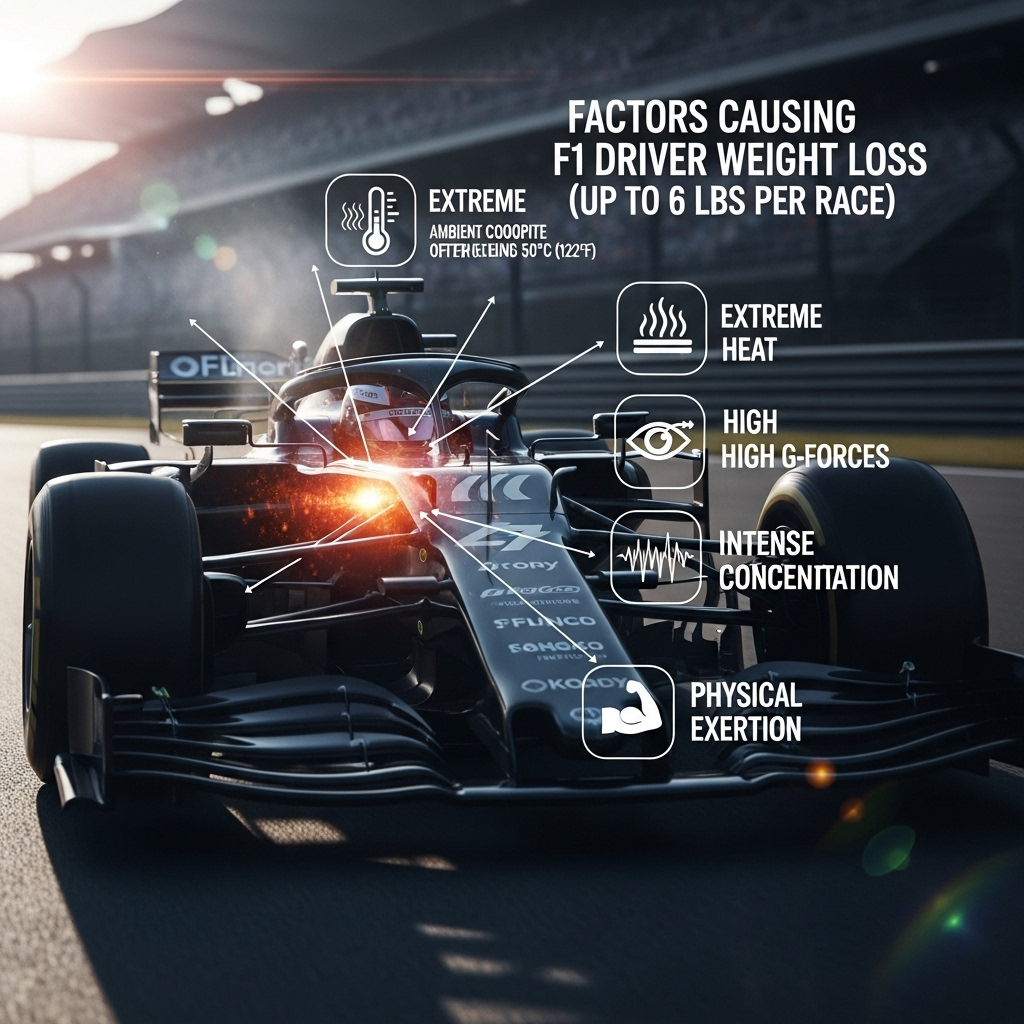
Losing a few pounds over a week is one thing, but losing it in under two hours is another entirely. The primary cause of this rapid weight loss is profound dehydration through sweating. An F1 car’s cockpit is a hostile environment, and several factors converge to push a driver’s body to its absolute limit.
- Intense Cockpit Heat: A Formula 1 cockpit is essentially a carbon fiber oven. With the driver wedged inside, surrounded by a roaring engine, hot electronics, and hydraulic systems, cockpit temperatures can exceed 122°F (50°C).
- Fireproof Race Suit: Drivers wear multi-layered, fire-retardant race suits, underwear, and balaclavas for safety. While essential for protection, these garments are not breathable and trap immense amounts of heat, accelerating the sweating process.
- Extreme Physical Exertion: An F1 car has no power steering. Drivers wrestle with incredible G-forces through every corner, braking zone, and acceleration. Braking can generate forces up to 6G, meaning the driver must push against a force six times their own body weight with their leg. Steering through high-speed corners requires immense upper body and core strength. This constant battle is a full-body workout.

The Science Behind Losing Up to 6 Pounds in Two Hours
The dramatic drop on the scales is almost entirely due to fluid loss. When the body is subjected to intense heat and physical stress, its primary cooling mechanism is sweating. For an F1 driver, this process is pushed into overdrive.
The loss of up to 6 pounds is a direct result of sweating out vital fluids. A gallon of water weighs approximately 8.34 pounds, so losing 6 pounds is equivalent to sweating out nearly three-quarters of a gallon of water. This isn’t fat loss; it’s a dangerous level of dehydration that must be carefully managed.
The body’s metabolic rate also skyrockets during a race. A driver’s heart rate can average 160-180 beats per minute for the entire race duration, peaking at over 200 bpm. This is comparable to a marathon runner’s effort, but sustained while also performing a mentally taxing, high-precision task. This elevated metabolic activity burns a significant number of calories—up to 1,500 per race—but the immediate, drastic weight change comes from water.
The Most Demanding Races on the F1 Calendar
While every race is taxing, some are notorious for pushing drivers to their physical breaking points. These are typically held in hot and humid climates, where the body’s ability to cool itself through sweat evaporation is severely hampered.
- Singapore Grand Prix: Widely considered the most physically demanding race. It’s a night race, but the heat and punishing humidity of the tropics remain. The twisting, stop-and-go nature of the street circuit means there are no long straights to rest.
- Miami Grand Prix: A newer addition to the calendar, Miami’s spring race has quickly earned a reputation for its oppressive heat and humidity, leading to drivers losing significant weight.
- Qatar Grand Prix: Another race held under intense heat, the conditions here have been known to push drivers past their limits, sometimes leading to sickness and extreme exhaustion post-race.
In these conditions, seeing a driver lose up to 6 pounds or even slightly more is not uncommon. It underscores the incredible fitness required to simply complete the race, let alone compete for the win. You can learn more about the unique challenges of each track on the official Formula 1 racing calendar.
How Drivers Prepare for and Recover from This Ordeal
No athlete could sustain this level of fluid loss without a meticulous preparation and recovery strategy. F1 teams and their performance coaches leave nothing to chance.
Before the Race: The process starts days before the lights go out. Drivers focus on “hyper-hydration,” systematically increasing their intake of water and electrolyte-rich fluids. This ensures their bodies start the race in a state of optimal hydration. Their diets are also carefully controlled to maximize energy stores. For more on this, check out our deep dive into F1 driver training regimens.
During the Race: Every F1 car is equipped with a drinks system, a small bag of fluid connected to a tube that runs to the driver’s helmet. They can take sips on the straights, but the fluid is often warm and unpleasant. Sometimes the system fails, leaving the driver with nothing to drink for the entire race.
After the Race: The moment a driver gets out of the car, recovery begins. They are immediately handed electrolyte drinks and cooling towels. The first order of business is to replenish the fluids and minerals lost. Their weight is checked before and after the race to quantify the fluid loss and tailor the recovery plan. This data is critical for the team’s sports scientists, who are constantly looking for ways to mitigate the effects of dehydration.
The Dangers of Extreme Dehydration in Motorsport
Losing a large volume of body fluid isn’t just uncomfortable; it’s extremely dangerous and directly impacts performance. Even a 2% loss in body weight due to dehydration can lead to a significant drop in focus, concentration, and physical strength.
For an F1 driver, a lapse in concentration for a fraction of a second can be disastrous. Dehydration can cause:
- Reduced Cognitive Function: Slower decision-making and reaction times.
- Muscle Cramps and Weakness: Affecting a driver’s ability to apply consistent brake pressure or turn the wheel.
- Blurred Vision: A terrifying prospect when navigating corners at 180 mph.
The fact that drivers can perform at such an elite level while enduring this level of dehydration is a testament to their conditioning. It highlights that they are not just drivers; they are some of the fittest and most resilient athletes on the planet. The ability to manage the loss of up to 6 pounds is as crucial as their ability to nail a perfect qualifying lap.

So, the next time you see a driver looking exhausted after a race, remember what their body has just been through. They haven’t just driven a car; they’ve survived an ordeal that pushes human endurance to its very edge.


