
Injured Protester: 1 German Police Tactic Scrutinized
A recent climate protest in Berlin turned chaotic, leaving dozens of demonstrators requiring medical attention and placing a controversial German police tactic under intense public and legal scrutiny. The use of the “Kessel,” or kettling, has reignited a fierce debate across Germany about the balance between maintaining public order and protecting the fundamental right to assemble. With each report of an injured protester, calls for reform grow louder.
This article delves into the controversial tactic, the events that unfolded in Berlin, and the growing backlash from human rights organizations and the public alike.
The “Kessel”: A Controversial Crowd Control Tactic Explained
The “Kessel,” which translates to “cauldron” or “kettle,” is a police tactic where officers form a tight, impenetrable cordon around a group of people, effectively trapping them inside. The stated purpose is to de-escalate a volatile situation, prevent a march from proceeding, contain disruptive elements, or facilitate targeted arrests. Officers, often in full riot gear, encircle a crowd, sometimes for hours on end.
While proponents argue it’s a non-lethal method for managing large-scale disturbances, critics argue it is inherently indiscriminate. The tactic often traps peaceful protesters, bystanders, and journalists alongside any disruptive individuals. This lack of differentiation is a primary source of criticism. Confining large numbers of people in a compressed space can lead to panic, crushing, and a denial of basic needs like water, sanitation, and medical assistance.
Historically, the tactic has been used in various forms across Europe, but it has a particularly contentious history in Germany, dating back to protests in the 1980s. Courts have, in the past, ruled specific instances of kettling as unlawful, yet the tactic remains a part of the police playbook for major demonstrations.
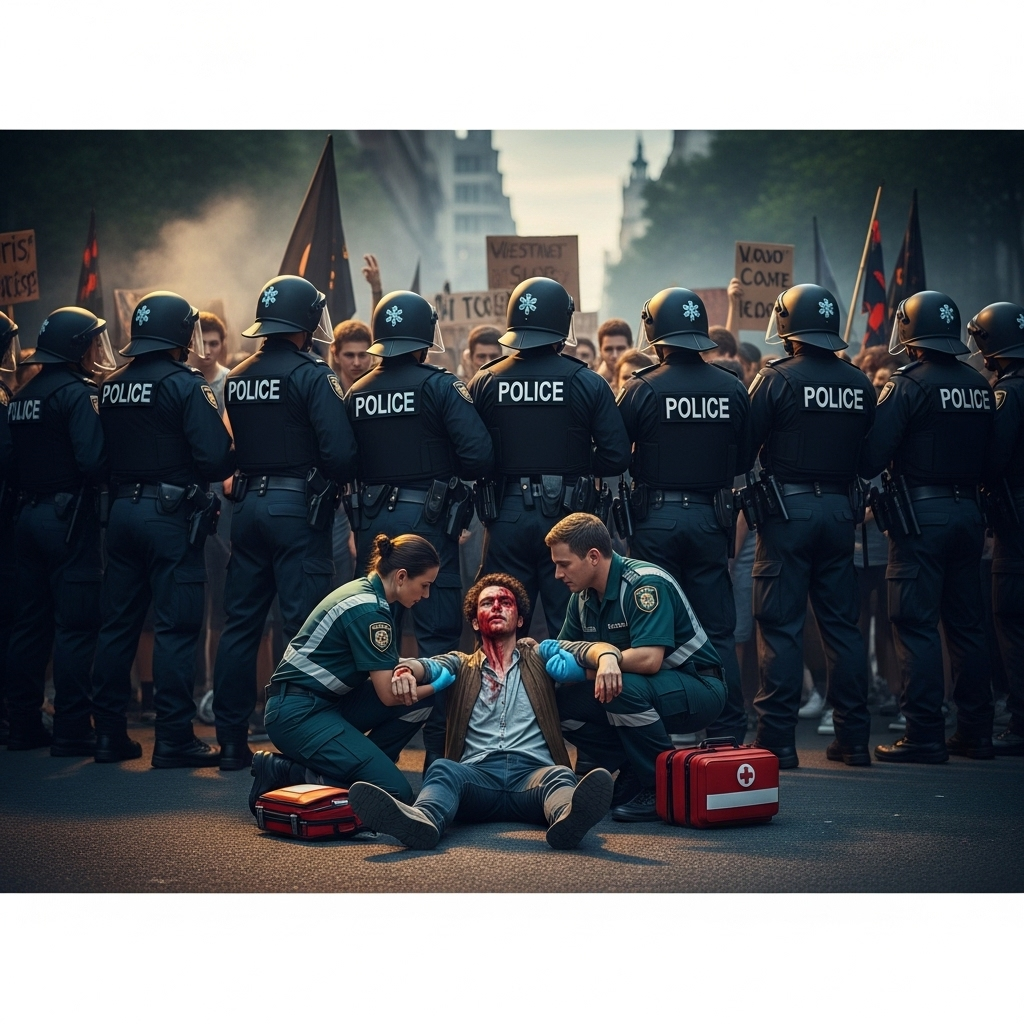
The Berlin Incident: How Protesters Were Injured
The recent “Fridays for Future” protest in Berlin began peacefully. Thousands gathered near the Brandenburg Gate to demand more aggressive government action on climate change. According to eyewitnesses, the mood was energetic but non-violent. However, as a splinter group attempted to march towards the Reichstag building, deviating from the approved route, police units moved in swiftly.
Instead of targeting the specific individuals, riot police deployed the “Kessel,” encircling a dense crowd of several hundred people. Eyewitness accounts and video footage show the cordon tightening, causing a surge in the crowd. What followed was several hours of confinement.
Reports from within the kettle described a terrifying scene. One injured protester, a university student, reported being crushed against a police line, suffering cracked ribs. Another described a severe panic attack as the crowd swayed and pushed. Access for paramedics was heavily restricted, with many of the injured being treated by fellow demonstrators with basic first-aid kits. The primary causes of injury were not direct police violence, but rather the consequences of the tactic itself: suffocation, trampling, and panic-induced falls.
The Aftermath for an Injured Protester: A Firsthand Account
Clara Schmidt, a 24-year-old graphic designer, was one of the many caught in the kettle. “It went from a peaceful demonstration to a nightmare in minutes,” she recounted. “One moment we were chanting, the next we were trapped. The circle of police just kept getting tighter. You couldn’t move, you could barely breathe.”
Clara explained that the panic was the most dangerous element. “People started shouting, crying. I saw an elderly man fall, and we were all screaming for the police to give us space, but they just stood there, impassive.” In the chaos, Clara was pushed to the ground, and her ankle was trampled, resulting in a severe sprain and ligament damage. Her story is just one of many highlighting the human cost of the tactic.
“I came to protest for the planet, and I left in an ambulance,” she said. “I am an injured protester not because I was violent, but because I was trapped. This wasn’t policing; it was a punishment for showing up.” Many like Clara are now considering legal action, not just for compensation, but to challenge the legality of the tactic itself. For more information on similar challenges, see our previous coverage on police reform efforts in Germany.

Legal and Human Rights Scrutiny
The Berlin incident has drawn sharp condemnation from human rights groups. Amnesty International released a statement calling the use of the “Kessel” in this context “a disproportionate and dangerous response” that violates the right to peaceful assembly.
Legal experts argue that for a kettle to be lawful, it must be a necessary and last resort to prevent serious public disorder. They contend that its application against a largely peaceful crowd was unjustified. Furthermore, holding people for hours without access to water, food, or medical care can be considered a violation of human rights. The principle of proportionality is key here: is the act of confining and potentially injuring hundreds of people a proportional response to a few dozen deviating from a protest route?
The collective nature of the tactic is also under fire. German law emphasizes individual responsibility. By trapping everyone, police fail to distinguish between peaceful participants and potential lawbreakers, effectively punishing the entire group. This lack of differentiation forms the basis of many legal challenges currently being prepared by civil liberties lawyers on behalf of each injured protester.

The Official Response and The Path Forward
In the face of mounting public pressure, the Berlin Police Department has defended its actions. A spokesperson stated that the “Kessel” was necessary to “prevent further escalations and a direct confrontation at the Reichstag.” They claimed that repeated orders to disperse were ignored and that the tactic was executed according to established protocols. They have also opened an internal investigation into the conduct of the officers and the numerous reports of injuries.
However, politicians from opposition parties are calling for an independent inquiry. They argue that police protocols that allow for such dangerous outcomes must be fundamentally re-evaluated. “A police force in a democracy must be able to de-escalate without resorting to methods that endanger the public they are meant to protect,” stated one Green Party representative.
The incident has forced a national conversation. The debate is no longer just about the single event in Berlin but about the broader philosophy of policing protests in a free society. As the stories of each injured protester come to light and legal battles commence, the future of the “Kessel” as a legitimate crowd control tool in Germany hangs precariously in the balance. The outcome will be a defining moment for civil liberties and police accountability in the nation.
“`


