
Governor Fumes: 1 Agent Brings Crackdown to Chicago
In a press conference that can only be described as incandescent, the Illinois governor fumes as a baffling and unprecedented situation unfolds on the streets of Chicago. A single, unidentified federal agent has, over the course of 72 hours, initiated a city-wide “crackdown” on minor civil infractions, throwing the metropolis into a state of bewildered chaos and triggering a jurisdictional firestorm that has reached the highest levels of state government.
The source of the governor’s rage is a lone operative, referred to in sparse federal communications only as “Agent K,” who is seemingly on a one-person mission to enforce every municipal code with ruthless efficiency. This has left local authorities paralyzed and citizens either ticketed or utterly confused.
The “K-pocalypse”: One Agent’s War on Trivial Offenses
The operation, now being dubbed the “K-pocalypse” by social media users, began quietly on Tuesday morning. Eyewitness reports described a figure in a nondescript grey suit issuing federal citations for infractions that typically warrant a warning at best. The first documented incident involved a food truck vendor on Michigan Avenue who was cited for his service window being “one-quarter inch” too low.
From there, Agent K’s activities escalated. Reports flooded the Chicago Police Department’s non-emergency lines. A cyclist was ticketed for having a handlebar streamer that “obstructed the optimal aerodynamic profile.” A pedestrian in Lincoln Park received a summons for “improperly distributed bird feed,” leading to what the ticket described as “pigeon congregation in excess of municipal standards.”
By Wednesday, the agent’s scope had widened. He was seen measuring the distance between parked cars with a laser device, issuing citations for vehicles “non-compliant with parallelity statutes.” Later, he reportedly shut down a hot dog stand for applying ketchup in a manner deemed “a cultural violation,” though no such statute exists. The agent’s authority appears to stem from his credentials from a little-known agency: the “Federal Department of Urban Order and Civic Harmony.”
Local police have been instructed not to interfere, as the agent’s credentials appear valid, however obscure. “Our hands are tied,” said one CPD precinct captain, who asked to remain anonymous. “He’s operating in a grey area we didn’t even know existed. We can’t arrest him, but we also can’t assist him. We’re just… watching.”

Why the Governor Fumes: A Jurisdictional Nightmare
At a heated press conference Friday, the reason the governor fumes became crystal clear. “This is an absurdity! It is a mockery of jurisdiction, a perversion of federal authority, and an insult to the people of Illinois,” the governor stated, his voice booming. “We have one agent, from an office nobody has ever heard of, terrorizing our citizens over crooked hats and poorly sorted recycling. It ends now.”
The governor’s legal team is scrambling to understand the mandate of the “Department of Urban Order.” It appears to be a dormant agency created by an obscure executive order in the 1970s, intended to “promote aesthetic and procedural harmony in metropolitan centers.” It was seemingly never funded or staffed—until now. “This isn’t law enforcement; it’s bureaucratic performance art, and my city is the stage,” the governor added.
This unprecedented situation creates a legal and political nightmare. The state government is asserting its police power, the constitutional right of states to regulate behavior and enforce order within their territory. However, federal law can, in many cases, supersede state law. The challenge is that Agent K is not enforcing major federal statutes; he is enforcing local codes with federal authority, a legal pretzel that has constitutional scholars scratching their heads.
The governor has threatened to file an injunction with the Supreme Court if necessary. “I don’t care if I have to take this to the highest court in the land,” he declared. “No single agent is going to hold Chicago hostage. This is our state, our city, and our jaywalkers.” For more information on previous state-federal disputes, you can review our archives.
Public Reaction: From Confusion to Memes
Chicagoans, known for their resilience, have reacted with a characteristic blend of frustration and dark humor. The initial confusion quickly gave way to a city-wide sport of “Agent K spotting.” The hashtag #Kcrackdown is trending nationally, filled with pictures and videos of the stone-faced agent writing tickets for things like “non-regulation shoelace knots” and “loitering with ambivalent intent.”
Memes have flooded the internet. One popular image shows Agent K placing a tiny parking ticket on a child’s Big Wheel. Another superimposes his face onto the “Terminator” poster with the tagline: “Your recycling is non-compliant.”
Interviews with residents reveal a deep sense of the surreal. “I was walking my dog, and he, you know, did his business,” said Maria Flores, a 34-year-old graphic designer. “I bagged it, of course. But this man in a suit appeared out of nowhere and told me the bag’s color—lime green—was ‘visually disruptive to the autumnal park palette.’ I thought it was a prank. It was not. It’s a $200 federal fine.”
Another resident, 72-year-old retiree Stan Kowalski, was cited for “excessive squirrel familiarity” after being observed feeding a regular visitor on his porch. “He called the squirrel ‘Unregistered Urban Fauna’ and told me I was creating a dependency,” Stan lamented. “I’ve been feeding ‘Nutsy’ for five years!”
The Federal Response (Or Lack Thereof)
Perhaps the most maddening aspect of the situation for the governor is the deafening silence from Washington D.C. Inquiries to the White House have been met with befuddlement. The Department of Justice claims to have no knowledge of the operation. Illinois’s congressional delegation has been making frantic calls, only to be met with bureaucratic stonewalling.
The “Department of Urban Order” has no public-facing website or listed phone number. Its headquarters is listed at an address that, upon investigation, was found to be a mail-forwarding service above a laundromat in Delaware. All attempts to get a comment, a clarification, or even a confirmation of Agent K’s mission have failed.
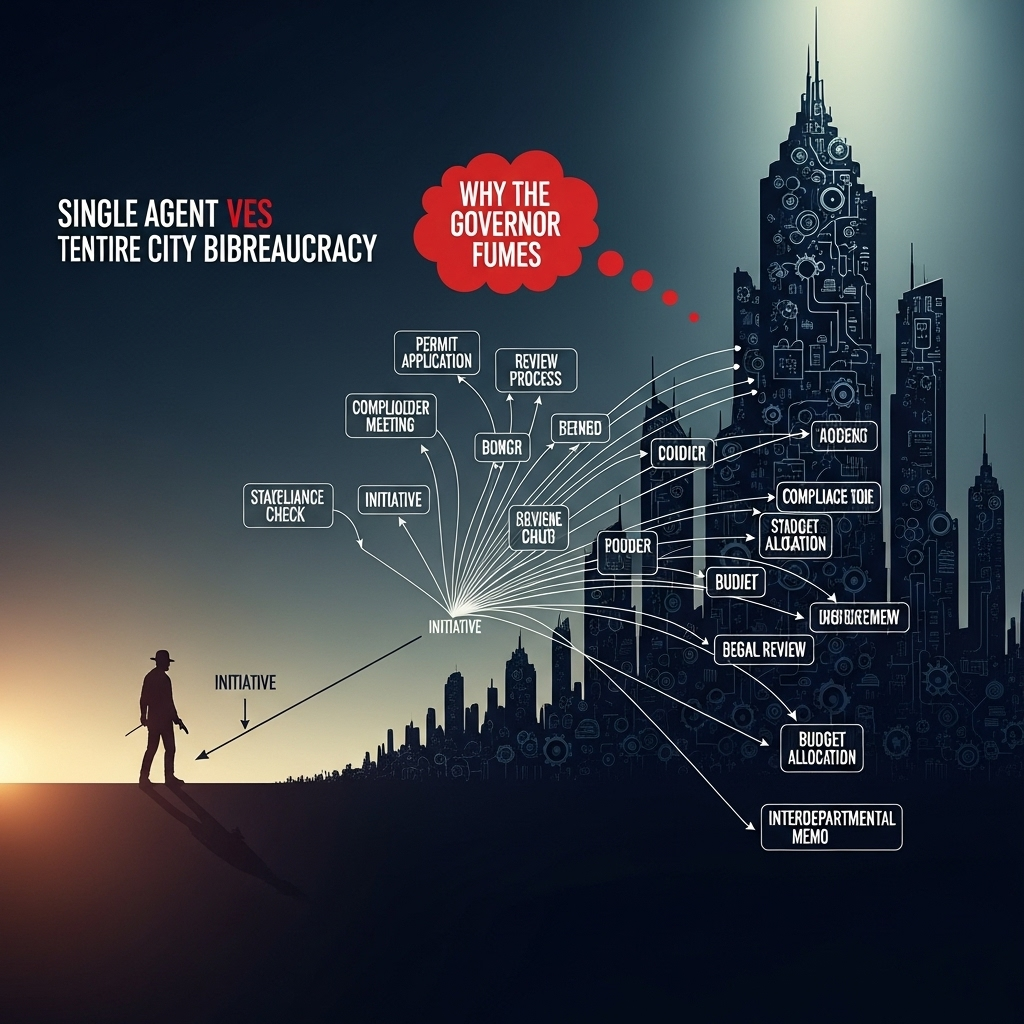
This information vacuum has fueled intense speculation. Is Agent K a rogue operative? Is this a bizarre, unannounced social experiment? Or has a single, deeply buried bureaucratic directive been activated by mistake, unleashing a force of pure, unadulterated pedantry upon an unsuspecting city? Whatever the answer, the federal government’s inability to explain or recall its own agent is a major reason the governor fumes with such public intensity.
What’s Next for Chicago?
As the weekend approaches, Chicago remains in a state of high alert and high absurdity. The governor has put the Illinois National Guard on “standby for legal and logistical support,” a move that is largely symbolic but underscores the seriousness of the state’s position. The city’s legal department is working around the clock to find a loophole to neutralize Agent K’s authority within city limits.
Meanwhile, Agent K continues his mission, unbothered by the political storm brewing around him. He was last seen attempting to issue a citation to the Buckingham Fountain for “excessive and non-utilitarian water expenditure.” The fountain, being an inanimate object, could not accept the ticket.
For now, the standoff continues. A city of millions and a powerful state government are being held in check by one man, a clipboard, and a rulebook no one else has ever read. The governor’s fury is palpable, and a resolution seems distant, ensuring that this bizarre chapter in Chicago’s history is far from over.


