
Ominous Turn: 1 Reagan Speechwriter on Political Violence
Editor’s Note: The following is an opinion piece from a former speechwriter for the Reagan administration, reflecting on the current state of American political discourse.
I remember the hum of the electric typewriter, the weight of a well-crafted phrase, and the overarching sense of optimism that defined our work. In the Reagan White House, our guiding star was the concept of a “shining city upon a hill”—a beacon of freedom and democratic ideals. We engaged in fierce debates with our political opponents, but the battles were of ideas, not of fists or threats. Looking at the landscape today, it’s clear our nation’s discourse has taken an ominous turn.
The casual acceptance of political violence, the dehumanizing rhetoric, and the threats against public servants are not just partisan squabbles; they are a corrosive acid eating away at the very foundations of our republic. As someone who helped articulate a vision of American strength rooted in unity, I find this current chapter not just disappointing, but deeply alarming.
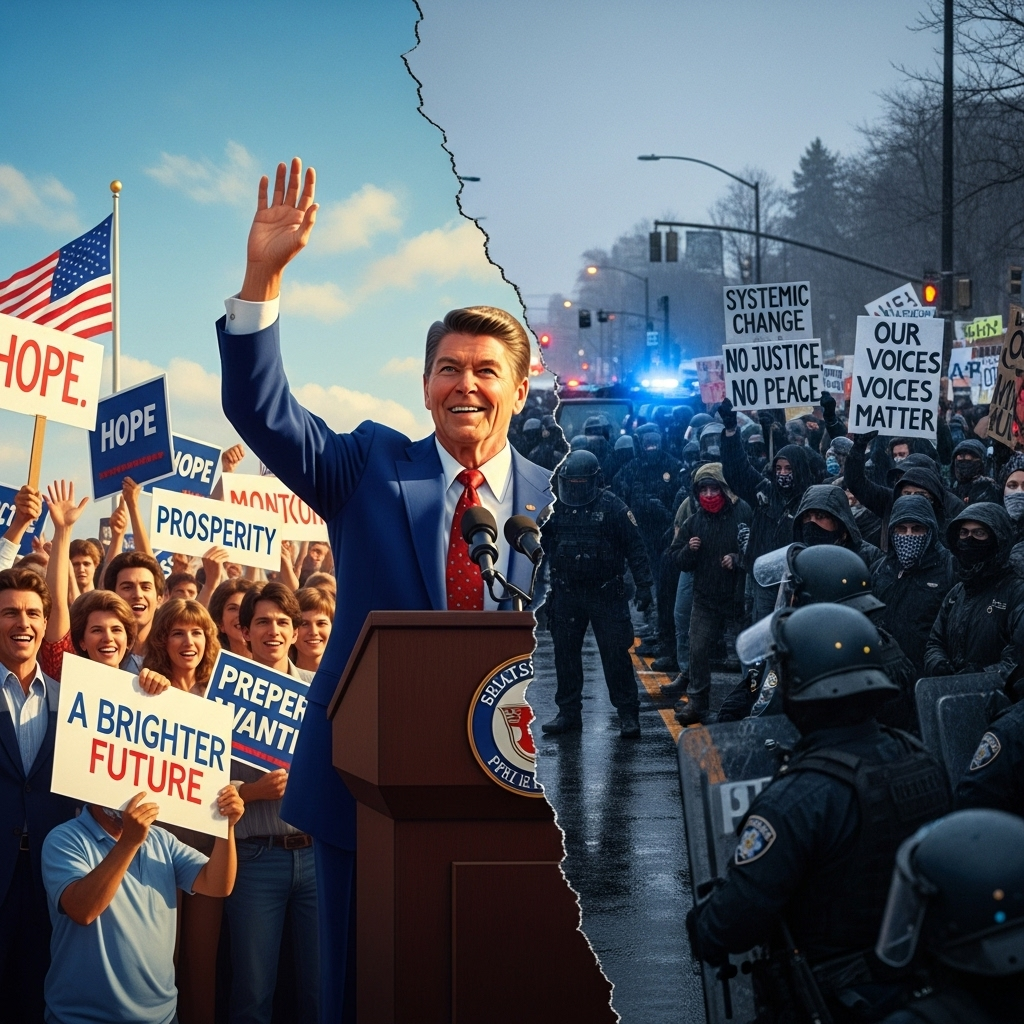
The Rhetoric of Then vs. Now
President Reagan famously said, “The person who agrees with you 80 percent of the time is a friend and an ally, not a 20 percent traitor.” This philosophy underpinned our entire approach. He could share a laugh and a drink with House Speaker Tip O’Neill after a day of brutal political combat. Why? Because they both saw each other as Americans first, and partisans second. They respected the institutions they served and the voters who elected them.
Today, that sentiment feels like a relic from a distant past. Political opponents are no longer just “the other side”; they are labeled as “enemies,” “traitors,” or “vermin.” This isn’t just heated rhetoric; it’s a deliberate strategy of dehumanization. When you strip your opponent of their humanity, you open the door to actions that were once unthinkable.
We crafted speeches to inspire and unite, even when delivering hard truths. The goal was to build a coalition, to persuade the undecided, to appeal to what Abraham Lincoln called the “better angels of our nature.” The dominant strategy now seems to be to inflame the base, to sow division, and to profit from outrage. This shift represents a fundamental breakdown of the civic contract.
The Ominous Turn From Words to Actions
Words have consequences. The steady drumbeat of violent imagery and conspiratorial accusations has taken its inevitable, ominous turn into real-world action. We are now witnessing a level of political intimidation that would have been unimaginable in the 1980s. Election workers—the non-partisan backbone of our democracy—face death threats for simply doing their jobs. Judges are threatened for upholding the law. Members of Congress from both parties require security details not for foreign threats, but for threats from their fellow citizens.
This didn’t happen in a vacuum. It is the direct result of leaders and media figures who have decided that winning at all costs is more important than upholding democratic norms. They have normalized the idea that violence is a legitimate tool of political expression. For more on this, you can read about the impact of social media on our political divide.
The line between metaphorical political “warfare” and literal violence has been deliberately blurred. When you tell people their country is being “stolen” by a corrupt cabal, you cannot be surprised when some of them decide to take up arms to “save” it. This is a fire that, once lit, is incredibly difficult to extinguish.
Eroding the Guardrails of Democracy
Perhaps the most dangerous aspect of this trend is the systemic erosion of trust in our core institutions. The judiciary, the free press, federal law enforcement, and our very electoral system are under constant assault. President Reagan, a famous critic of “big government,” still fundamentally believed in the American system. His goal was to make government work better for the people, not to burn it to the ground.
When leaders tell their followers not to trust election results, not to trust courts, and not to trust the news, they are not just attacking an institution; they are attacking the concept of a shared reality. A republic cannot function without it. According to recent studies from organizations like the Pew Research Center, public trust in government is at a historic low.
This is the endgame of the politics of pure destruction. If nothing is true, and no institution is trustworthy, all that is left is raw power. This is the fertile ground where political violence grows, and it is the most significant ominous turn of all.
A Call for Leadership: Can We Pull Back?
I refuse to believe that this is an irreversible decline. The vast majority of Americans, whether on the left, right, or in the center, do not want to live in a country defined by hatred and fear. They go to work, raise their families, and wish for a better future for their children. They are the “great silent majority” that is exhausted by the perpetual conflict.
What is missing is leadership. We need leaders from all sides to step forward and unequivocally condemn political violence and intimidation, regardless of who the target is. They must do so without “whataboutism” or partisan qualification. They must remind Americans that we have more in common than that which divides us.
It’s a call back to a basic sense of civic duty and responsibility. It’s about putting country over party and the long-term health of the republic over short-term political gain. It’s not a naive wish; it is the essential requirement for our survival as a free society.
The work we did in the 1980s was about telling a story of American greatness—a story of a resilient, hopeful, and united people. That story is still true, but it is being drowned out by the noise of anger and division. The path we are on is dark and dangerous. Before this ominous turn becomes a point of no return, we must find the courage and the leadership to choose a different direction and remember the enduring strength of the shining city we are meant to be.
“`


