
Rendezvous Robotics Secures $3M for Space Infrastructure
In a significant boost for the future of in-space operations, startup Rendezvous Robotics has successfully closed a $3 million seed funding round. This investment will fuel the development of its autonomous robotic systems designed for servicing, assembling, and manufacturing in Earth’s orbit and beyond.
Article Contents
What is the Mission of Rendezvous Robotics?
At its core, Rendezvous Robotics is tackling one of the most complex challenges for a sustainable space economy: creating the physical infrastructure in orbit. The company is developing advanced robotic platforms capable of performing intricate tasks that are currently impossible or prohibitively expensive.
Their mission is to provide the “hands and eyes” in space. This encompasses a range of capabilities known as ISAM (In-space Servicing, Assembly, and Manufacturing). Instead of launching massive, monolithic satellites, Rendezvous Robotics envisions a future where smaller components are launched and then assembled into larger structures by their autonomous systems.
This includes tasks like:
- Satellite Life Extension: Refueling, repairing, or upgrading existing satellites to extend their operational lifespan.
- Orbital Assembly: Constructing large antennas, solar arrays, or even entire space stations in orbit.
- Debris Mitigation: Actively capturing and de-orbiting dangerous space junk.
By enabling these services, the company aims to dramatically lower the cost of space operations and unlock new commercial opportunities that are currently confined to science fiction.
Breaking Down the $3M Seed Round
The $3 million funding round was led by Stellar Ventures, a venture capital firm known for its early-stage investments in deep-tech and aerospace. The round also saw participation from Orbit Capital and a consortium of angel investors with deep roots in the space industry.
According to the company, this capital injection will be strategically deployed to achieve several key milestones over the next 18-24 months. The primary focus will be on accelerating the development and testing of their core technologies. This involves moving from digital simulations to physical, ground-based prototypes that can validate the hardware and software in a controlled environment.
Furthermore, the funds will be used to expand their world-class engineering team, bringing in experts in robotics, AI, and guidance, navigation, and control (GNC) systems. A portion of the investment is also earmarked for securing a launch opportunity for an initial technology demonstration mission, which will prove their system’s capabilities in the harsh environment of space.
A Closer Look at the Technology
The centerpiece of the Rendezvous Robotics solution is a dual-system architecture: “Haven” and “Nightingale.”
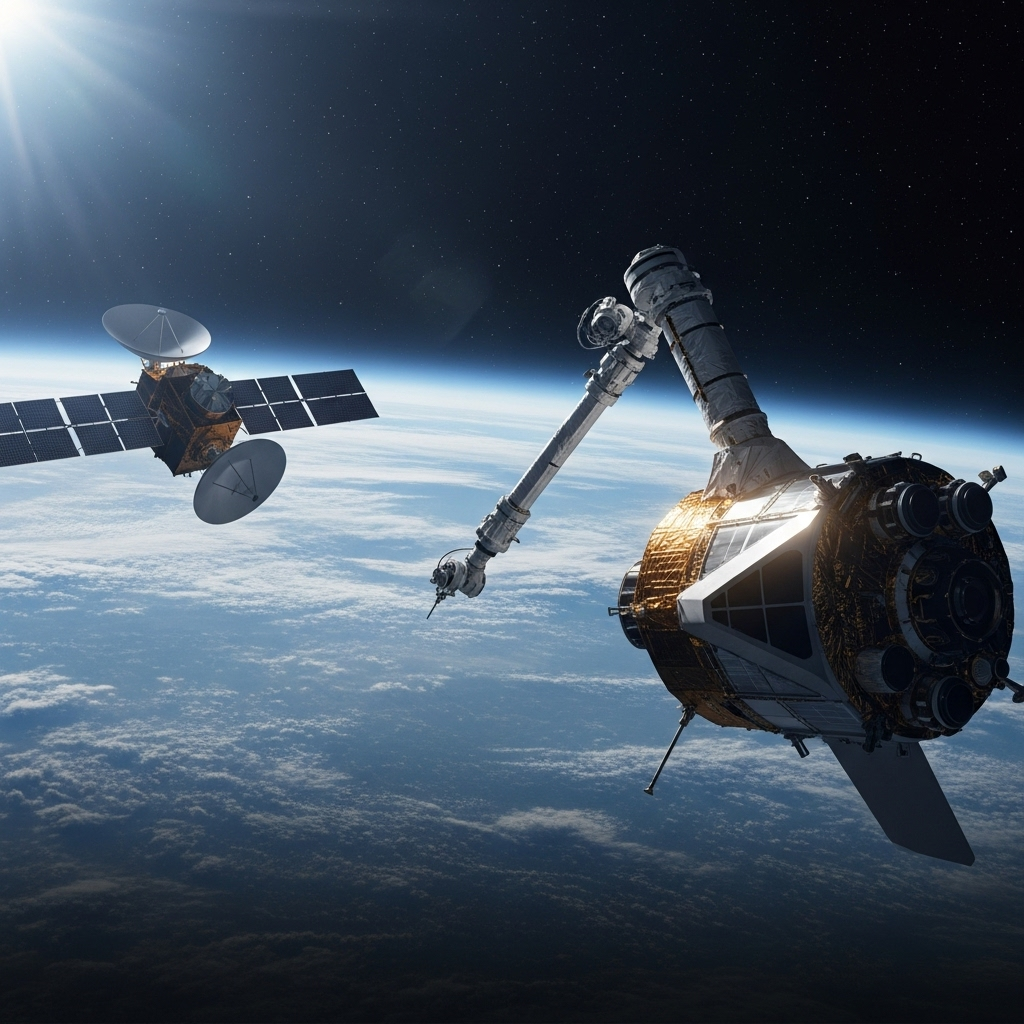
The “Haven” is the servicer spacecraft. It is a highly agile vehicle equipped with advanced sensors and an AI-powered flight computer. Its primary role is to perform the rendezvous and proximity operations (RPO) — safely approaching and matching orbit with a target object, whether it’s a cooperative satellite or an inert piece of debris.
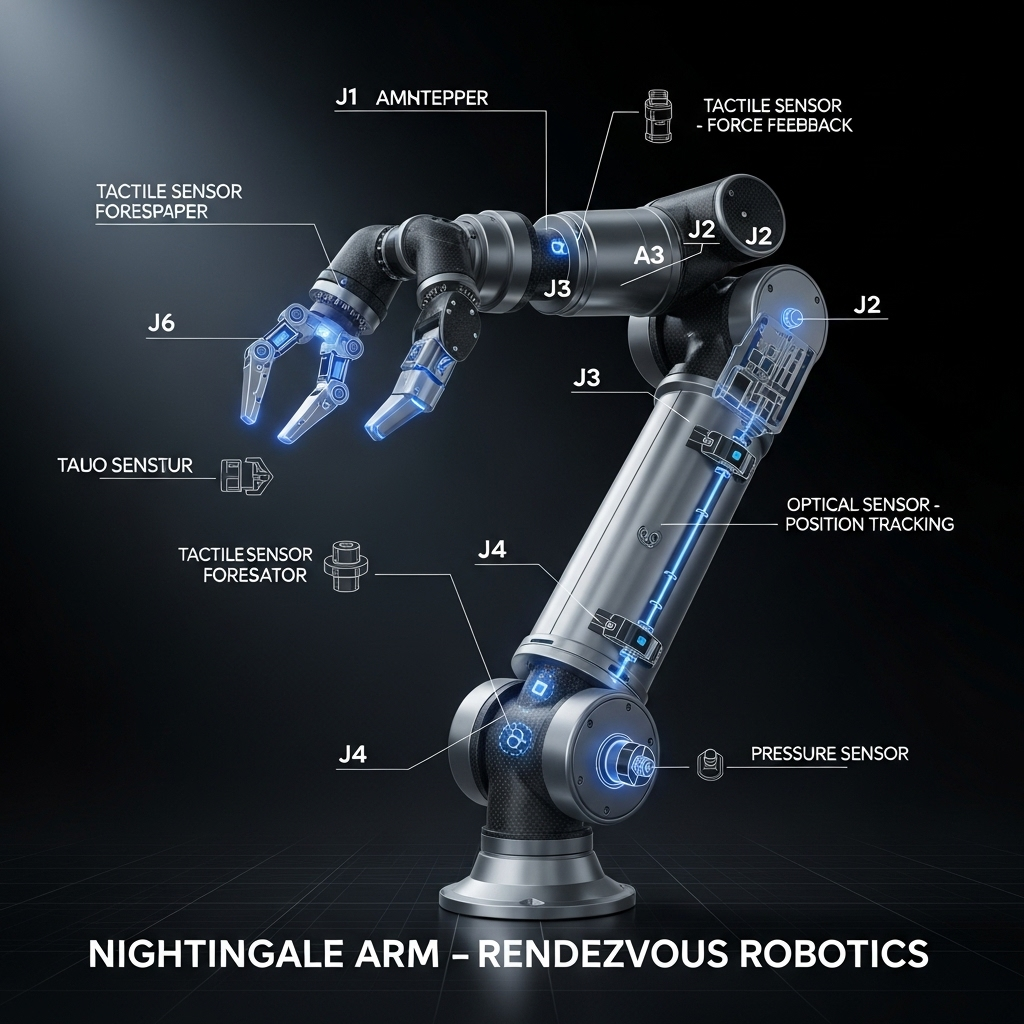
Attached to the Haven is the “Nightingale,” a highly dexterous and robust robotic arm. Inspired by the precision of a surgeon’s hand, the Nightingale is designed for fine motor tasks. It uses a combination of machine vision and force-feedback sensors to manipulate objects, operate tools, and connect modular components with incredible accuracy.
The entire system is built on a foundation of autonomy. While human operators can remain in the loop for critical decisions, the platform is designed to perform most tasks independently, reducing communication latency and operational costs. This reliance on AI-powered guidance is what sets their approach apart from previous-generation teleoperated robotic systems.
The Exploding Market for In-Space Services
The timing for Rendezvous Robotics could not be better. The commercial space economy is growing at an unprecedented rate. Thousands of new satellites are being launched each year, creating a massive, orbiting infrastructure that requires maintenance and management.
Currently, when a satellite runs out of fuel or a key component fails, it becomes a multi-million-dollar piece of space junk. This is not only a financial loss but also contributes to the growing problem of orbital debris, which poses a threat to all active missions.
Companies like Rendezvous Robotics are proposing a paradigm shift towards a more sustainable and circular economy in space. By offering reliable servicing, they can keep valuable assets operational for longer. By enabling in-space assembly, they allow for the creation of structures far larger than what can fit into a single rocket fairing, paving the way for next-generation space telescopes, solar power stations, and commercial habitats.
This emerging market is projected to be worth billions of dollars within the next decade, and early movers who can demonstrate reliable and cost-effective technology are poised to capture a significant share.
Leadership Vision and What’s Next
Leading the charge is CEO and co-founder Dr. Elara Vance, a former robotics lead from a major aerospace contractor. Her vision is clear and ambitious.
“We aren’t just building a single-use robot; we are building the foundational tools for an off-world civilization,” Dr. Vance stated in a recent press release. “Think of our systems as the construction crews, mechanics, and logistics operators for the bustling city that orbit will become. This funding allows us to take the critical next steps in making that vision a reality.”
The roadmap for Rendezvous Robotics is aggressive. The immediate goal is a successful ground demonstration of the Nightingale arm’s capabilities. Following that, the team will focus on integrating the full Haven/Nightingale system and preparing for its first orbital test flight.
If they succeed, Rendezvous Robotics won’t just be a successful startup; they will be a critical enabler of humanity’s future in space, turning the vast emptiness of orbit into a workshop for innovation.

“`


