
US Energy Chief: 10 Years to Fusion Power Breakthrough
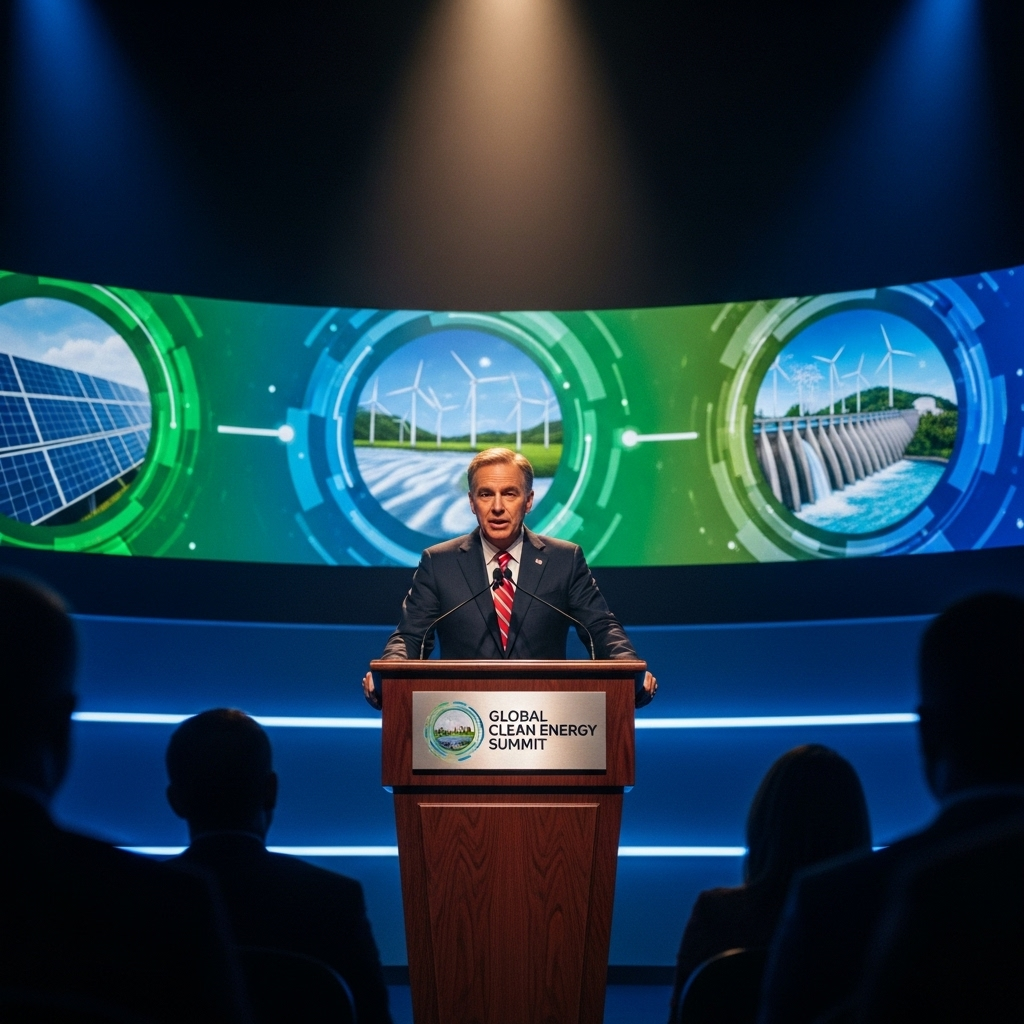
In a landmark announcement that sent ripples through the scientific and energy sectors, the current US Energy Chief declared a bold and ambitious timeline for one of humanity’s most sought-after technological advancements. During a keynote address at the Global Clean Energy Summit, they stated that the United States is on a path to achieve a major fusion power breakthrough within the next decade, a development that could fundamentally reshape our world and solve the climate crisis.
This proclamation is not just wishful thinking; it’s backed by a surge in federal funding, strategic public-private partnerships, and recent scientific advancements that have brought the dream of limitless clean energy closer than ever before. For decades, fusion power has been the “holy grail” of energy production, always seeming to be 30 years away. Now, according to the nation’s top energy official, that timeline has been dramatically accelerated.
Article Contents
The US Energy Chief’s Bold Proclamation
The core of the announcement from the US Energy Chief centers on a “decadal vision” for commercial fusion energy. “We are no longer talking about if, but when,” they stated to a packed auditorium. “The scientific progress, particularly in the last 24 months, has given us the confidence to set a concrete goal. We aim to have a pilot fusion power plant design ready and a breakthrough in sustained net energy gain within 10 years.”
This statement builds on the historic achievement at the Lawrence Livermore National Laboratory’s National Ignition Facility (NIF) in late 2022, where scientists achieved “net energy gain” for the first time. This means they produced more energy from a fusion reaction than the laser energy used to ignite it. While a monumental scientific victory, the challenge has been to replicate and scale this process in a way that can power a city.
The new initiative, championed by the Department of Energy, aims to bridge that exact gap. It focuses on moving from single-shot laboratory experiments to the continuous, high-yield reactions necessary for a commercial power plant. The 10-year goal is a powerful motivator, designed to focus resources and talent on solving the remaining engineering and materials science challenges.
What Exactly is Fusion Energy?
To understand the magnitude of this goal, it’s essential to grasp what fusion is. In simple terms, fusion is the process that powers the sun and other stars. It involves forcing light atomic nuclei, such as hydrogen isotopes like deuterium and tritium, to fuse together under immense pressure and temperature. When they combine, they form a heavier nucleus (like helium) and release an enormous amount of energy.
This process differs fundamentally from nuclear fission, which is what powers today’s nuclear power plants. Fission involves splitting heavy atoms like uranium, a process that creates long-lived radioactive waste. Fusion, on the other hand, offers several key advantages:
- Abundant Fuel: The primary fuels, deuterium and lithium (to breed tritium), can be extracted from seawater and the Earth’s crust. The fuel supply is virtually limitless.
- Inherent Safety: A fusion reaction is incredibly difficult to start and maintain. Any disruption in the precise conditions will cause the reaction to stop almost instantly, making a meltdown-style accident impossible.
- Clean Energy: Fusion does not produce carbon dioxide or other greenhouse gases. Its primary byproduct is helium, an inert and harmless gas. It produces no long-lived, high-level radioactive waste.
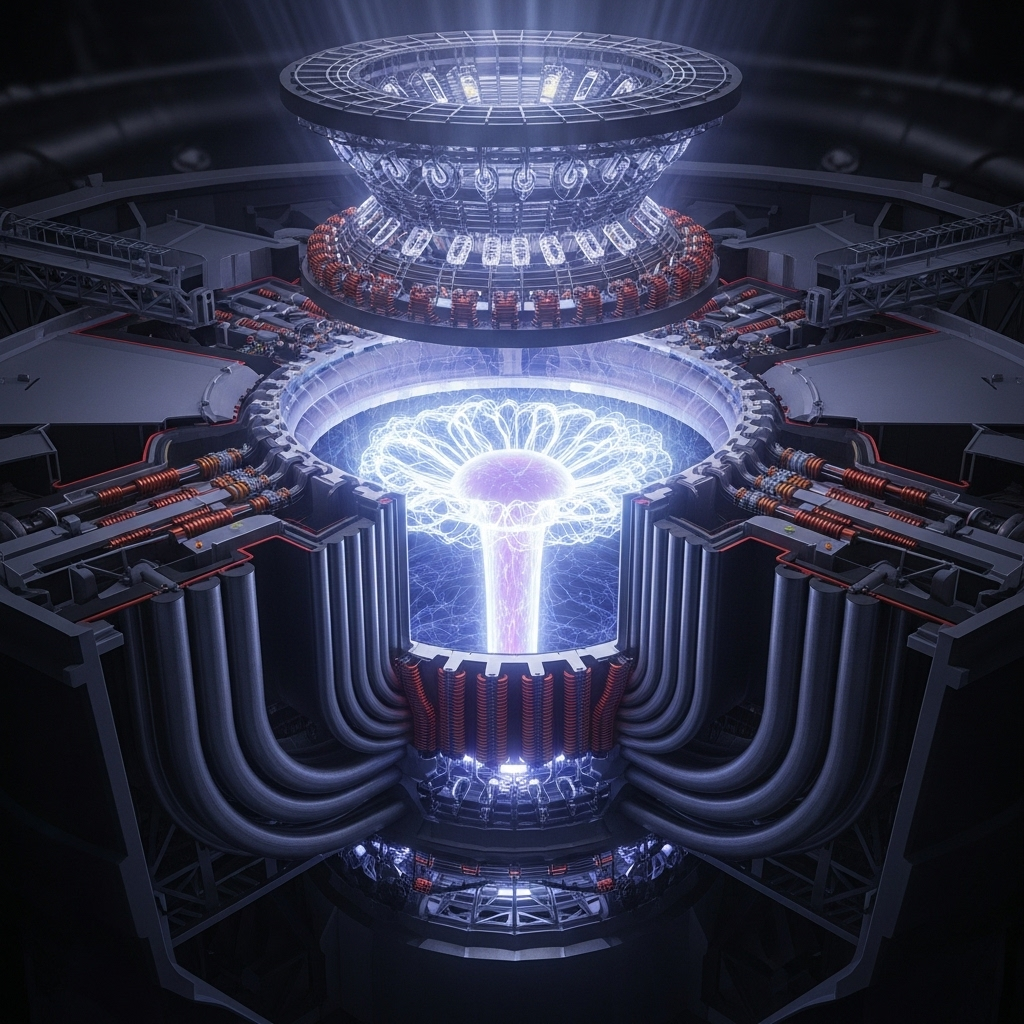
Harnessing this stellar power on Earth is the goal. Most research focuses on using powerful magnetic fields to contain the superheated fuel, known as a plasma, in a donut-shaped device called a tokamak. Getting this plasma hot enough and dense enough for a sustained period is the central challenge that scientists are now on the verge of solving.
Hurdles on the Path to a Fusion Future
Despite the optimism from the US Energy Chief, the road ahead is not without significant obstacles. Moving from a lab-based “proof of concept” to a grid-connected power plant requires overcoming immense engineering hurdles. The primary goal is achieving and sustaining a “burning plasma,” where the heat from the fusion reactions themselves is enough to keep the reaction going without significant external energy input.
Another major challenge involves materials science. The internal components of a fusion reactor must withstand conditions more extreme than the surface of the sun—intense heat and a constant bombardment of high-energy neutrons. Scientists and engineers are racing to develop new materials that can survive these conditions for years on end without degrading.
Finally, there’s the tritium fuel cycle. While deuterium is abundant, tritium is a radioactive isotope with a short half-life and must be produced, or “bred,” within the reactor itself. Perfecting a closed-loop system where the reactor produces its own tritium fuel is a critical step for commercial viability. These are the problems that the new decadal initiative is designed to tackle head-on.
Government Initiatives and Private Sector Synergy
The strategy outlined by the Department of Energy, under the guidance of the US Energy Chief, is not a go-it-alone government project. It is heavily reliant on a burgeoning ecosystem of private fusion companies. In recent years, venture capital has poured billions into startups that are pursuing innovative and often faster-paced approaches to fusion energy.
The government’s role is shifting to support these pioneers. The DOE’s Milestone-Based Fusion Development Program, for instance, provides funding to private companies as they achieve specific, pre-agreed-upon scientific and technical goals. This approach fosters competition and innovation while ensuring taxpayer money is tied to demonstrable progress.
This public-private model leverages the strengths of both sectors. The government can fund fundamental, high-risk research and provide access to its world-class national laboratories, while private companies bring agility, commercial focus, and a powerful drive to get a product to market. This synergy is what gives leaders like the US Energy Chief the confidence to set such an aggressive timeline for this transformative clean energy solution.

The Global Race for a Fusion-Powered World
The United States is not alone in its quest. A global race for fusion power is well underway, with major international players investing heavily. The most significant international effort is ITER (International Thermonuclear Experimental Reactor) being built in France. This massive collaboration between 35 nations aims to be the first fusion device to produce net energy on a massive scale and sustain it for long durations.
Beyond ITER, countries like China and the United Kingdom have their own aggressive national programs. China’s EAST tokamak has set records for sustaining high-temperature plasma, while the UK is moving forward with its STEP (Spherical Tokamak for Energy Production) program, which also aims to have a prototype plant online in the 2040s.
The US initiative, however, is unique in its heavy emphasis on leveraging private industry to accelerate the timeline. By fostering a competitive domestic ecosystem, the US hopes to not only contribute to the global scientific effort but also to lead the commercialization of fusion technology, creating a new industry and securing American leadership in the clean energy economy of the 21st century. The recent proclamation by the US Energy Chief is a clear signal that the race has officially entered a new, more urgent phase.
“`


