
Wounded Soldier’s 21st Century Escape: E-Bike by Drone
On the modern battlefield, the minutes and hours following an injury are the most critical. For a wounded soldier isolated from their unit, the traditional wait for a Casualty Evacuation (CASEVAC) helicopter can be a life-or-death gamble against time and enemy fire. Now, a groundbreaking new system promises to rewrite the rules of personnel recovery by delivering a lifeline directly from the sky: a rugged, all-terrain electric bike delivered by a heavy-lift drone.
This innovative concept, currently undergoing advanced field trials, combines autonomous drone technology with specialized mobility solutions to empower a stranded soldier to initiate their own extraction. It’s a 21st-century solution to one of warfare’s oldest problems—how to safely and quickly get your people out of harm’s way.
Table of Contents
The Perilous Wait: The Challenge of Modern CASEVAC
The “golden hour” is a term etched into the mind of every combat medic and military planner. It refers to the crucial first hour after a traumatic injury where prompt medical intervention has the highest chance of preventing death. However, on a contested battlefield, achieving this is fraught with challenges. A conventional CASEVAC operation involves dispatching a helicopter or ground vehicle, which are loud, vulnerable targets for enemy air defenses and ground forces.
Factors that complicate traditional extractions include:
- Contested Airspace: The presence of enemy anti-aircraft systems can make flying a helicopter a suicide mission.
- Difficult Terrain: Dense jungles, narrow urban canyons, or mountainous regions can prevent vehicles or helicopters from reaching a soldier’s exact location.
- Time Delay: Coordinating and launching a rescue mission takes time—time a wounded soldier may not have.
These delays not only increase medical risk but also place additional personnel in danger. Sending a rescue team can often result in more casualties, compounding the tragedy. This is the tactical problem that military innovators, like those at DARPA, are working tirelessly to solve.

Enter the ‘Gryphon’ and ‘Stallion’: Drone and E-Bike Synergy
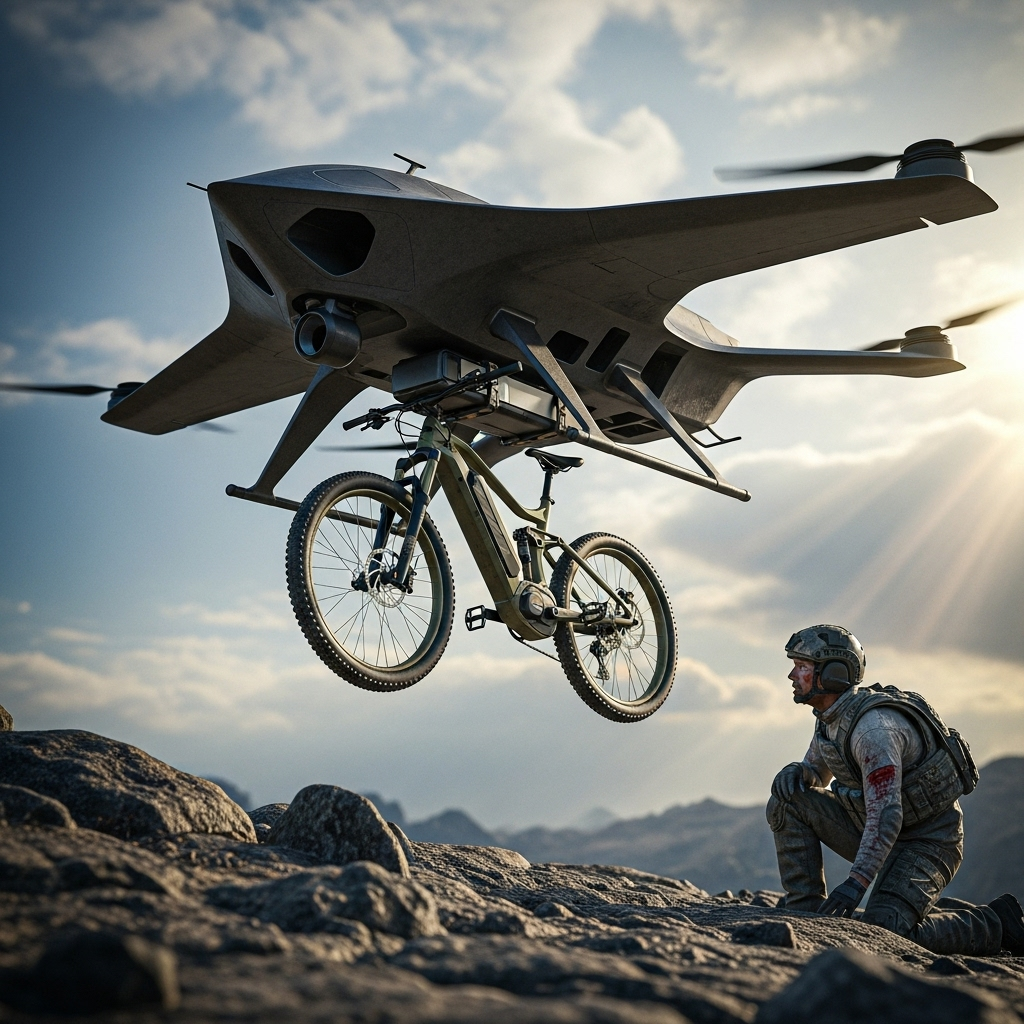
The solution is a two-part system designed for rapid, low-signature deployment. It consists of the “Gryphon” heavy-lift drone and the “Stallion” all-terrain e-bike.
The Gryphon drone is the backbone of the operation. It’s a semi-autonomous quadcopter designed for stealth and payload capacity. With a low-noise electric propulsion system and advanced radar-absorbent materials, it can penetrate contested airspace with a significantly lower risk of detection than a traditional helicopter. Its primary mission is to carry the Stallion e-bike to a precise GPS coordinate, often within meters of the stranded soldier’s position.
The Stallion e-bike is no ordinary bicycle. It is a purpose-built mobility platform featuring:
- A Silent Hub Motor: Allows for quiet movement to avoid attracting unwanted attention.
- Rugged, Fat-Tire Design: Capable of traversing mud, sand, and rocky terrain that would stop a normal vehicle.
- Simple, Intuitive Controls: Designed to be operated by a soldier who may be injured, disoriented, and under extreme stress.
*Long-Range Battery: Provides enough power for a soldier to travel dozens of miles to a designated safe extraction point.
Once the Gryphon drone reaches its target location, it can perform a low-altitude drop of the bike, which is encased in a protective, quick-release frame. The soldier then receives an alert on their tactical device, retrieves the bike, and can immediately begin moving toward safety.
A New Lifeline for the Wounded Soldier
For a wounded soldier who is ambulatory but unable to cover long distances on foot, this system is a game-changer. Instead of being a static, vulnerable target waiting for rescue, they are empowered with mobility and agency. This shift has profound physical and psychological benefits.
The ability to self-recover drastically reduces the time spent in the most dangerous phase of post-injury survival. A soldier on a Stallion e-bike can cover ground far faster and more efficiently than one on foot, quickly increasing their distance from immediate threats. This allows them to reach a pre-arranged Rally Point (RP) or a friendly Forward Operating Base (FOB) under their own power.
The psychological impact cannot be overstated. The feeling of helplessness while waiting for rescue can be debilitating. Providing a wounded soldier with a tool for self-reliance can boost morale and focus their mind on the task of survival. This transforms a passive victim into an active survivor. It gives them a measure of control in a situation where they previously had none. This concept is a core part of evolving modern soldier survival tactics.
From Concept to Reality: Testing and Future Implications
This drone-delivery system, born from collaborations between military research wings and private tech firms, has moved beyond the drawing board. Recent field exercises have demonstrated the system’s effectiveness in simulated combat scenarios. In one test, a Gryphon drone successfully delivered a Stallion e-bike to a “wounded” mannequin in a dense forest, which was then remotely guided to an extraction point five miles away.
The next phase of testing will involve live soldiers in complex training environments to refine deployment tactics and gather user feedback. The U.S. Army‘s Rapid Capabilities and Critical Technologies Office (RCCTO) is closely monitoring the program’s progress, seeing its potential to revolutionize personnel recovery doctrine.
The future implications are vast. The same Gryphon drone could deliver other critical supplies alongside the e-bike, such as advanced medical kits, ammunition, water, or communications equipment. A small fleet of these drones could support a platoon-sized element operating deep behind enemy lines, providing logistical support and an emergency extraction option without risking pilots or large vehicles.
As technology continues to evolve, the line between science fiction and battlefield reality blurs. The drone-delivered e-bike is a powerful example of how innovation is being harnessed not just to fight more effectively, but to bring every wounded soldier home safely.

“`


